November 5, 2025
|
5 min read



Blazingly fast way to build, track and deploy your models!
With the June 9, 2026 launch of Claude Fable 5, Anthropic now offers two tiers of frontier models to developers: the new Mythos-class Fable 5 and the established Opus 4.8. They're closely related; Fable 5's safeguards can fall back to Opus 4.8, but they're priced and positioned very differently.
In this blog, we compare Fable 5 vs. Opus 4.8 and understand how to choose and use both without rewriting your stack.
If you’re in a hurry, here's a quick comparison: Fable 5 is meaningfully more capable on long, complex, autonomous tasks and about 2x the price. Opus 4.8 is the better default for most everyday work when cost and latency matter. The smart move is to route by task: Fable 5 for the hard jobs, Opus 4.8 for the rest.
The main difference is the balance between capability and cost.
Fable 5 was introduced as Anthropic's most capable widely released model at launch, with a focus on demanding reasoning, software engineering, scientific research, knowledge work, and long-running tasks. Opus 4.8 was positioned for complex agentic coding and enterprise work.
If you are choosing between Fable 5 and Opus 4.8, Claude Fable 5 gives you the higher capability ceiling, particularly for complex coding and longer-running autonomous work. Claude Opus 4.8 costs less and still offers strong frontier-level performance, making it more practical when you need to run workloads at higher volume or keep inference costs under control.
Anthropic's documentation confirms the 1M-token context window, 128K maximum output, and pricing for Fable 5.
Model specifications and pricing can change. Verify the current provider documentation before implementing either model.
The biggest gap appears on harder, multi-step coding tasks. Fable 5 scores 11.1 points higher on SWE-Bench Pro and 15.9 points higher on FrontierCode. In practice, this advantage matters when you ask the model to work through a large codebase, debug across multiple files, or complete a longer autonomous task.
The benchmark results show a larger gap on the cited coding evaluations. However, benchmark scores measure specific tasks under specific evaluation conditions. They should not be treated as a complete measure of production routing performance.
For an enterprise evaluation, test representative workloads alongside benchmark results. Measure task completion, retries, latency, token consumption, structured-output accuracy, tool-use reliability, and the level of human intervention required.
What this means in practice
The takeaway: Don't treat the benchmark scores as a simple winner-takes-all comparison. Fable 5's advantage matters most when the workload is difficult and long-running; Opus 4.8 makes more sense when cost and throughput matter more.
Fable 5 costs twice as much per input and output token as Opus 4.8 at the prices used in this comparison.
Two cost nuances matter:
Still, for high-volume, simple, or latency-sensitive workloads, Opus 4.8 at half the price is usually the rational default.
The difference between Fable 5 and Opus 4.8 is not just about which model scores higher on a benchmark. If you are choosing one for production, you need to look at how it handles the work you actually give it.
Both models can handle complex prompts, but the important question is how they deal with problems that require several decisions before reaching an answer. For engineering teams, this matters when a task involves understanding requirements, breaking a problem into smaller steps, checking the result, and correcting mistakes.
A model can also look strong on a benchmark while behaving differently on messy, real-world inputs. If your prompts contain incomplete requirements, large amounts of context, or conflicting instructions, test how consistently each model reaches a useful result rather than relying on a single benchmark number.
Coding is more than generating a function from a prompt. In an engineering agentic workflow, the model may need to inspect existing code, identify the cause of an error, modify several files, run tools, interpret the output, and try again.
This makes agentic behaviour particularly important. When comparing the two models, look at how often they need human intervention, how well they recover from failed tool calls, and whether they can follow a task through to completion.
For teams building coding agents, repository-level tasks are therefore more informative than a simple code-generation test.
Long-running tasks introduce a different set of problems. The model has to remember what it was trying to achieve, keep track of completed steps, and avoid going down an unrelated path after several tool calls.
This is especially relevant for agents handling research, software development, data analysis, or multi-step automation. A useful test is to give both models the same task and measure not only whether they eventually finish it, but also how many corrections, retries, and human interventions are needed along the way.
Output quality also depends on what your application needs from the model. A chatbot that only returns short text has different requirements from an application that needs strict JSON, long code outputs, tool calls, or structured responses that are passed directly into another system.
Check the supported output formats, context and output limits, and how reliably the model follows a required structure. Small failures here can create additional parsing, validation, or retry work in production.
Safeguards can have a direct impact on how an application behaves. A model may refuse some requests, ask for clarification, or restrict parts of a response depending on the nature of the task.
For developers, the important part is understanding how those safeguards affect legitimate use cases. Test the model with representative prompts from your application instead of assuming that a general safety description tells you everything about its production behaviour.
There is no single metric that captures whether a model fits your workload. The right choice depends on what you are asking it to do and what that work costs at scale.
For example, an agent running a long coding task may benefit from strong reasoning and reliable tool use, while a high-volume application processing thousands of shorter requests may place more weight on token pricing, latency, and predictable output.
That is why Fable 5 and Opus 4.8 should be evaluated against the workload you actually plan to run. Compare task completion, retries, latency, token consumption, and human intervention alongside benchmark scores and headline pricing.
This is the part that's easy to miss: Fable 5 and Opus 4.8 are directly linked. Fable 5 ships with safeguard classifiers for cybersecurity, biology/chemistry, and distillation. When a request trips one, Fable 5 hands it to Opus 4.8 and the user is notified. Anthropic says this happens in under 5% of sessions.
Practical implications:
There is no universal model choice for every workload. The appropriate model depends on capability requirements, cost constraints, latency expectations, and application behavior.
You don't necessarily need to standardise on one model. In production, a better approach can be to use both and decide where each request should go.
For example, you could send routine, high-volume requests to Opus 4.8 and reserve Fable 5 for tasks where stronger reasoning or longer-horizon execution justifies the additional cost. This gives you a way to control spend without putting every request through the same model.
The routing logic can be based on a few practical signals:
This becomes much easier when both models are managed through the same gateway. With the TrueFoundry AI Gateway, Fable 5 and Opus 4.8 can sit behind a single
OpenAI-compatible endpoint. You can therefore change the model used for a request without maintaining separate integrations for each provider or model.
The setup can be kept fairly simple.
From the connected Anthropic provider in TrueFoundry, enable claude-fable-5 and claude-opus-4-8 from the Models Selection screen. You can also use Access Control to determine which teams or applications can access each model.
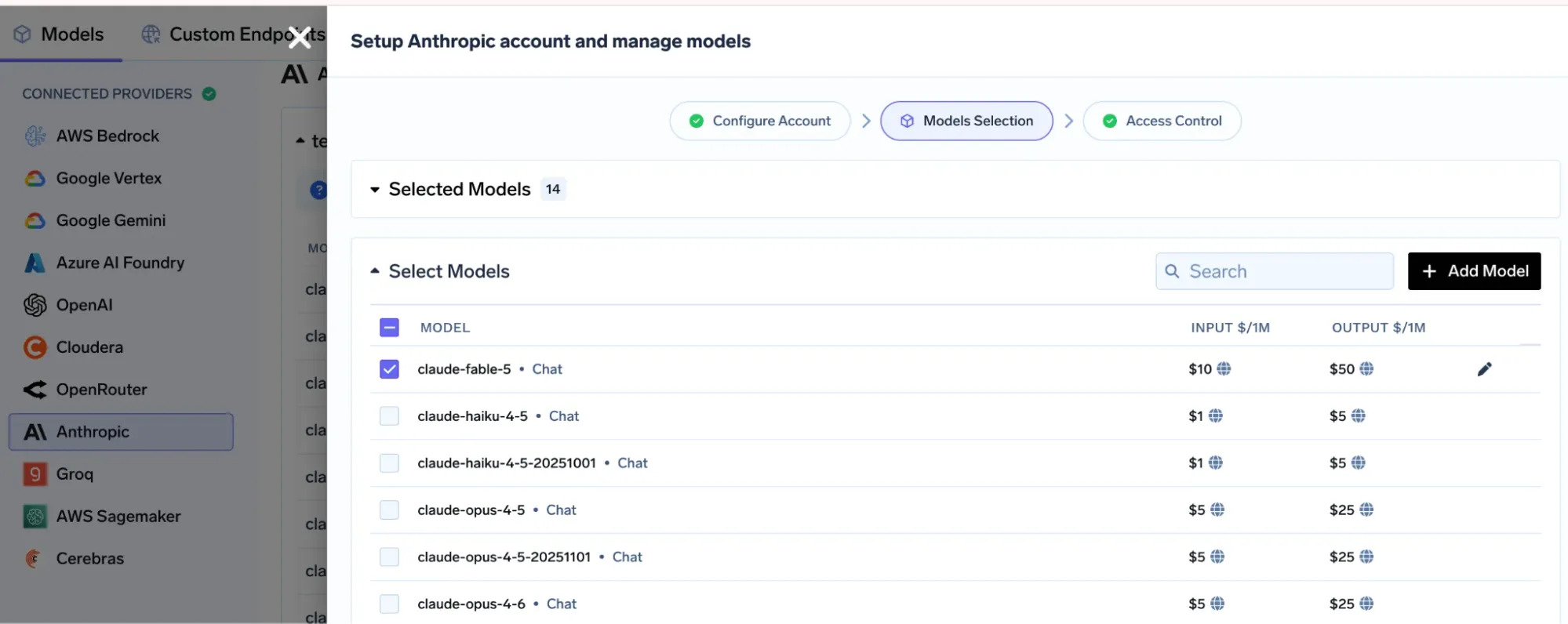
From the Playground, select the model you want to use and copy the usage snippet. Since both models are available through the same gateway base URL, switching between them mainly comes down to changing the model ID.
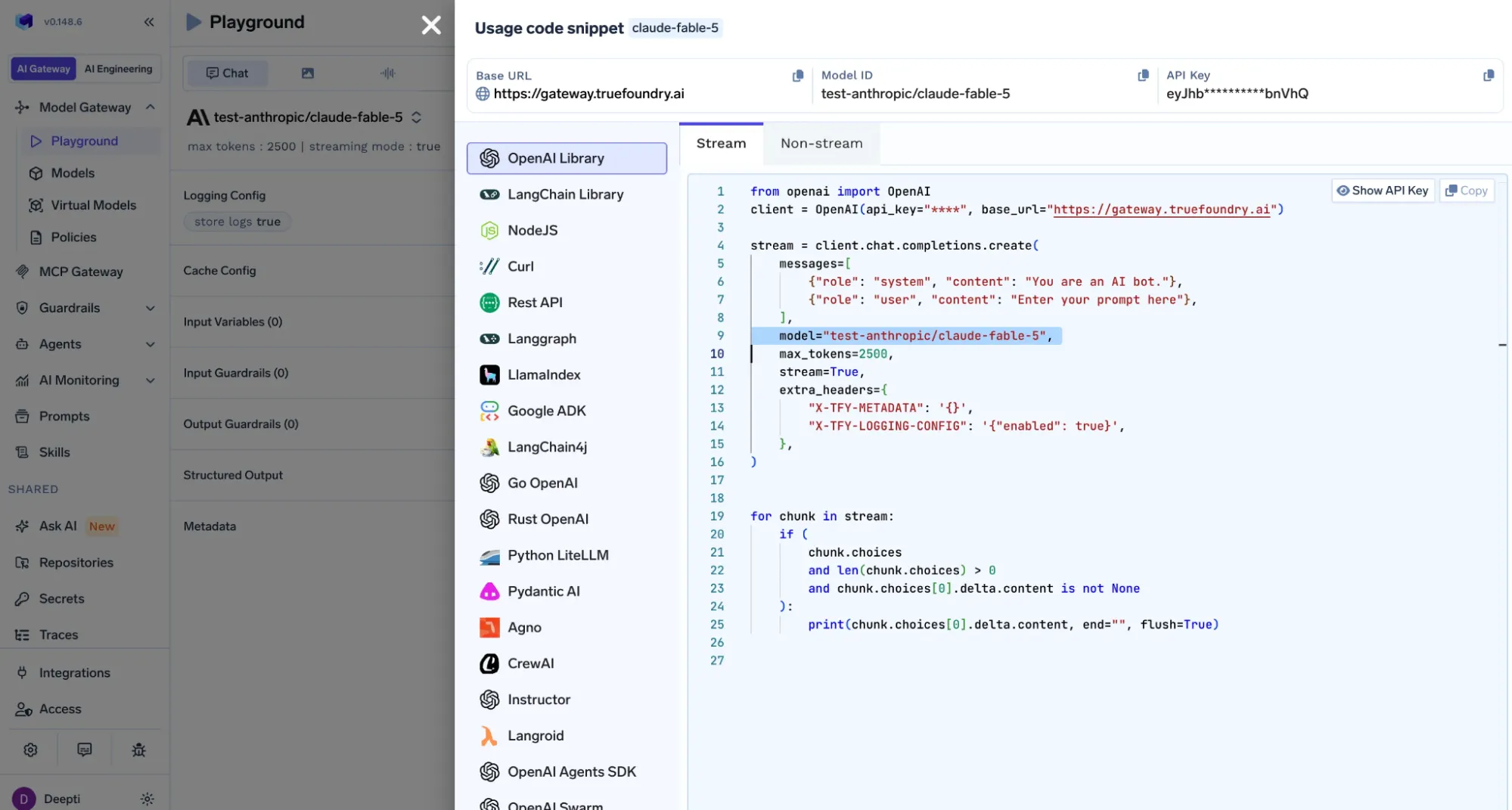
This also gives you room to change the routing strategy later. You could start with Opus 4.8 as the default, route selected workloads to Fable 5, and then adjust those rules as you collect real usage data.
The important part is to measure the routing decision rather than treating it as a one-time choice. Track cost, latency, task completion, retries, errors, and fallback frequency across both models. If Fable 5 is being used for tasks where Opus 4.8 produces the same result, you have an obvious opportunity to reduce spend. If cheaper routing leads to more retries or human intervention, the apparent saving may not be a real saving.
That makes model routing more than a way to switch between two APIs. It becomes a way to match model capability to workload requirements while keeping cost and operational controls in one place.
Sign up to see how TrueFoundry AI Gateway helps you route workloads across models, control costs, and manage AI usage from a single OpenAI-compatible gateway.
TrueFoundry AI Gateway delivers ~3–4 ms latency, handles 350+ RPS on 1 vCPU, scales horizontally with ease, and is production-ready, while LiteLLM suffers from high latency, struggles beyond moderate RPS, lacks built-in scaling, and is best for light or prototype workloads.


Anthropic’s published benchmarks show Fable 5 ahead on several demanding coding and reasoning tests, including SWE-Bench Pro and FrontierCode. The difference is more relevant for complex, long-running tasks; for routine workloads, Opus 4.8 may still meet your requirements at a lower cost.
Fable 5 costs $10 per million input tokens and $50 per million output tokens. Opus 4.8 costs $5 and $25 respectively. That makes Fable 5 roughly twice the price on both input and output tokens.
Anthropic says some flagged cyber, bio-chemical, or model-distillation requests may be routed from Fable 5 to Opus 4.8. This applies to a small share of sessions, and those requests are billed at the Opus 4.8 rate rather than the Fable 5 rate.
Fable 5 is positioned for more demanding reasoning, coding, and long-horizon agentic workloads. However, benchmark differences do not mean that Opus 4.8 cannot perform these tasks. The practical difference depends on task complexity, accuracy requirements, cost, and how much supervision your workflow needs.
Fable 5 is the newer, higher-priced model, while Opus 4.8 costs about half as much per input and output token. Their reported benchmark performance also differs, particularly on complex coding and reasoning workloads.
Yes. Both models can be accessed through the same TrueFoundry AI Gateway endpoint. You can route requests to either model using its model ID, allowing your application to switch between models without maintaining separate integrations.
Check the current model documentation before implementation, as context limits can vary by model and API configuration. Context window size should be evaluated alongside output limits, pricing, and actual prompt requirements rather than treated as the only capacity metric.
Yes. If you are selecting a model for a new deployment, compare the models currently available for your platform rather than relying only on a Fable 5 vs Opus 4.8 comparison. Anthropic's current documentation lists newer models, including Fable 5.1 and Opus 5.5.
For workloads where Opus 4.8 provides sufficient quality, its lower token price can make it a practical option. Teams can also use both models, routing more demanding tasks to Fable 5 while keeping routine or high-volume traffic on Opus 4.8.



The latest news, articles, and resources sent to your inbox