


.webp)
October 24, 2026
|
5 min read


Blazingly fast way to build, track and deploy your models!
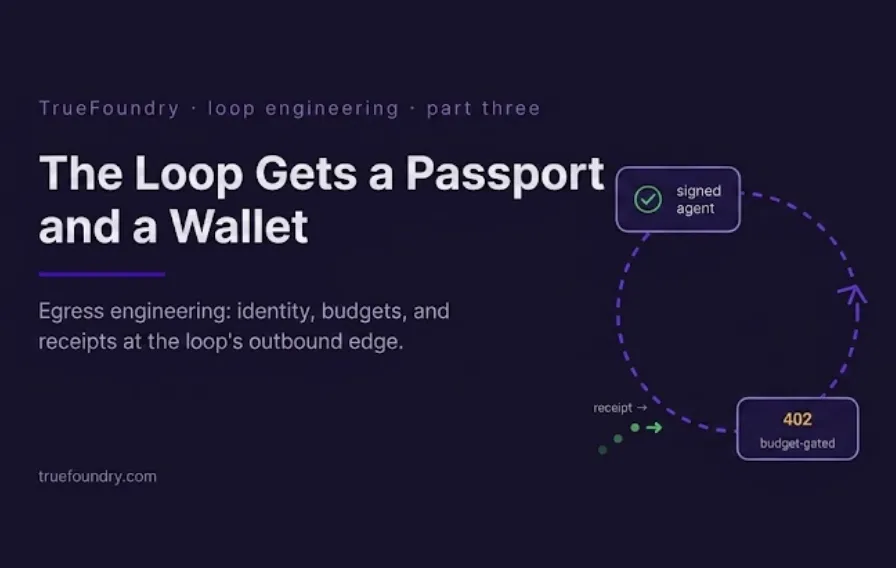
This blog has treated loop engineering as an inward discipline twice: our first loop-engineering post argued that the self-continuing loop belongs to a governed runtime, and our fleet-runtime post extended that argument from one loop to many. A related outward problem became more concrete from late 2025 through mid-2026. In October 2025, the IETF formed the Web Bot Auth working group to develop cryptographic authentication methods for automated clients accessing primarily human-oriented websites (current protocol draft; working-group formation notice, approved charter). On April 2, 2026, the Linux Foundation launched the x402 Foundation to steward the open x402 protocol for HTTP-native payments — as "an open, community-governed home" for the protocol, in Linux Foundation CEO Jim Zemlin’s words at launch (linuxfoundation.org). And on July 1, 2026, Cloudflare opened the waitlist for its announced Monetization Gateway — which plans to let customers charge any caller, explicitly including AI agents, for pages, datasets, APIs, or MCP tools behind its network, settled over x402 — writing plainly that "agents should pay for the inputs they need" (blog.cloudflare.com). Read together — and reading them together is this post's editorial synthesis — some origins and services are beginning to present automated clients with explicit identity or payment terms: identify yourself, and pay as you go. Some agent loops that plan, act, verify, and continue may increasingly encounter those gates and meters at their outbound edge. That gives loop engineering a third discipline, after the runtime inside the loop and the fleet around it: egress — the governed management of a loop's identity, spend, and conduct on networks the enterprise does not control.
Amara, a platform engineer at a research-heavy enterprise, noticed the problem in the gap between two logs. Her team's competitive-intelligence loop — a scheduled agent that plans a research question, fetches sources, verifies claims against them, and continues until its checklist is satisfied — had started returning confident summaries with oddly thin citation lists. The agent's own trace showed no errors: it planned, it fetched, it wrote. The egress log told the other half of the story: a growing fraction of its fetches were coming back 403 from sites that had tightened bot policies, and a handful were coming back 402 from a partner's newly metered API — a status code her retry logic treated as transient, so the loop had politely re-requested the same priced resource eleven times before giving up and writing around the gap. Nothing crashed. Nothing alerted. The loop simply got quieter, consumed additional model and orchestration resources through its retries, and returned outputs that were less complete and less well-supported. Amara's one-line incident summary is the thesis of this post: the loop's inside was governed; its outside was not. (Amara is an illustrative composite; the failure modes are the point.)
The individual developments are separately scoped, and each is worth stating precisely. x402 acquired a neutral governance home. On April 2, 2026, the Linux Foundation launched the x402 Foundation — the governing body for the x402 protocol, initially developed by Coinbase, Cloudflare, and Stripe, with Google, Visa, Microsoft, and some twenty other technology and payments organizations expressing initial support (linuxfoundation.org). The protocol's mechanism revives HTTP's long-dormant 402 status code: a client requests a payment-gated resource; the server responds with a price and payment instructions; the client pays and repeats the request with proof attached. Metering moved from experiment toward product. Cloudflare's Pay Per Crawl launched in July 2025 as a private-beta experiment in charging AI crawlers for content (blog.cloudflare.com); on July 1, 2026, the company opened the waitlist for its announced Monetization Gateway, which plans to extend per-request pricing from crawlers to any caller and from pages to datasets, APIs, and — notably for this series — MCP tools (announcement). Cloudflare says sites on its network send more than one billion HTTP 402 responses per day to bots and crawlers attempting to access content and commerce properties (blog.cloudflare.com). These are payment-required responses, not completed transactions. Separately, Cloudflare announced that beginning September 15, 2026, newly onboarded domains would default to blocking Training and Agent categories on pages displaying ads, while Search would remain allowed by default and customers could change the configuration (blog.cloudflare.com). And Web Bot Auth entered an IETF standards process. Web Bot Auth — Cloudflare's 2025 proposal that bots and agents cryptographically sign requests — gathered an IETF working group in October 2025, a Signature Agent Card registry draft first published in 2025 and revised in May and June 2026 with an Amazon co-author joining, and early production signing from major AI providers, per the drafts and coverage in Section 2. None of these alone remakes the web. Together they describe some origins and services that have begun attaching more explicit access and payment policies to some categories of machine traffic — with terms: who are you, and who is paying?
A scope note this post keeps throughout: the two rails are not one system. Per its IETF charter, Web Bot Auth addresses cryptographic identification of automated clients accessing primarily human-oriented websites — it explicitly excludes HTTP APIs, agent-to-agent interfaces, and identification of the end user behind an agent. Separately, x402-style payment systems are being applied to a wider set of HTTP-addressable resources, including pages, datasets, APIs, and MCP tools. This post reads both as evidence that loop egress may increasingly encounter explicit identity or payment policy, while recognizing the two efforts have different scopes.
For thirty years, "which bot is this?" was answered by a user-agent string anyone could type and an IP range anyone on it could borrow. Web Bot Auth adds cryptographic evidence beyond that guesswork: under the current protocol draft, an automated client signs each request with a private key (HTTP Message Signatures, RFC 9421), advertises itself via a Signature-Agent header, and publishes its public keys in a well-known directory (key-directory draft) so any origin can verify the signature independently (current protocol draft; reference implementation at github.com/cloudflare/web-bot-auth). The surrounding machinery matured across 2025–2026: Cloudflare folded message signatures into its Verified Bots program in July 2025 (blog.cloudflare.com), launched a signed-agents track that August (blog.cloudflare.com), and a Signature Agent Card registry draft — carrying an agent’s identity, operator, expected request rates, and keys — was first published in 2025 and revised in May and June 2026, with an Amazon co-author joining the Cloudflare authors; it remains an evolving Internet-Draft (current draft). Adoption is early and uneven — Cloudflare says OpenAI’s ChatGPT agent signs requests using Web Bot Auth (source), Amazon offers signing support in an AgentCore Browser preview (AWS docs), and Vercel supports verification of Web Bot Auth traffic (Vercel changelog) — implementations, not universal coverage; the direction matters more than the census: origins are gaining a reliable way to admit the agents they choose and refuse the rest. For a loop, the implication is structural. When an agent or orchestration layer swallows access failures, a loop without presentable identity may not fail loudly on a gated web; unsigned or refused requests can lead to incomplete sourcing rather than a visible terminal error, which lands the damage precisely where the industry already has a measured weakness: verification. An identified loop, by contrast, is a loop the web can choose to serve — carrying not just a signature but an answerable lineage: cryptographic evidence of which signing client is associated with which operator. End-user authority remains a separate enterprise identity and delegation control, outside Web Bot Auth’s charter.
The payment half changes the loop's control flow more intimately, because it lives inside the loop's most basic reflex: the retry. In an x402-enabled exchange, a 402 response can function as a structured payment request rather than an ordinary failure. MPP defines a related but distinct flow — a service returns a payment request and the agent authorizes payment before receiving the resource; Stripe’s public description does not characterize that flow as HTTP 402-based. In x402, the server names a price and payment details; the client decides whether to pay and, when authorized, repeats the request with payment proof. Fold that into a self-continuing loop and several things follow. Price becomes a step-level signal. When a loop encounters a quoted cost, it may need to weigh, mid-flight, whether a given fetch, API call, or MCP tool invocation is worth its price against the task's remaining budget — a decision that previously existed only at invoice time, if at all. The failure modes invert. Amara's eleven polite retries against a priced endpoint illustrate the benign version; the expensive version arrives when an auto-payment policy authorizes repeated or distinct requests without adequate idempotency, deduplication, or budget checks — a client that merely retries an unpaid 402 wastes calls without purchasing anything, but a policy that re-authorizes each new quote multiplies spend, the fan-out economics our fleet post examined, now with a meter attached to every branch. Caching becomes a purchasing strategy. Re-buying what the organization already bought is the new re-computing what it already computed; a paid response is an asset worth remembering — where freshness, licensing, privacy, and authorization constraints permit. And receipts become part of operational accountability. When a payment record is cryptographically and operationally bound to the request and caller identity, it can support an audit trail showing the requested resource, the authorized amount, and whether settlement was attempted or completed. It does not by itself prove successful delivery, source quality, or output correctness. That record belongs in the same per-step trace as the tool calls it accompanies, both for finance and for the cost and access record needed for operational accountability. None of this requires believing any particular settlement rail wins. It requires noticing that the loop's outbound edge can acquire transaction semantics, and that transaction semantics without governance is how pilots become invoices.
Our first loop post argued the loop belongs to a runtime — sandbox, credentials, gates, record — and our fleet post argued the runtime must scale to many loops without multiplying its controls. Both are inward-facing. What the metered web adds is outward-facing, and it is coherent enough to name as a discipline — offered, as our frameworks are, as editorial synthesis rather than settled doctrine. Egress engineering is the governed management of everything a loop does beyond the enterprise boundary, and its components mirror the inward set with satisfying symmetry. Identity: the loop presents who it is — signed requests where the rail supports them, but more fundamentally an identity brokered per agent with per-user delegation behind it, so "who did this" has an answer deeper than a key. Policy: what the loop may buy, from whom, and at what ceiling — the outbound twin of the tool allowlist. Enforcement: spend bounded in the request path, not reconciled after the month closes — warn-only modes for discovery, hard modes for production, thresholds that fire before ceilings do. Record: receipts and access decisions joined to the loop's per-step trace, so a run's cost, sources, and authority are answerable from one place. The symmetry is the argument: enterprises did not accept ungoverned credentials inside the loop, and there is no reason to accept ungoverned identity and spend at its edge — least of all now that participating edges can bill by the request.
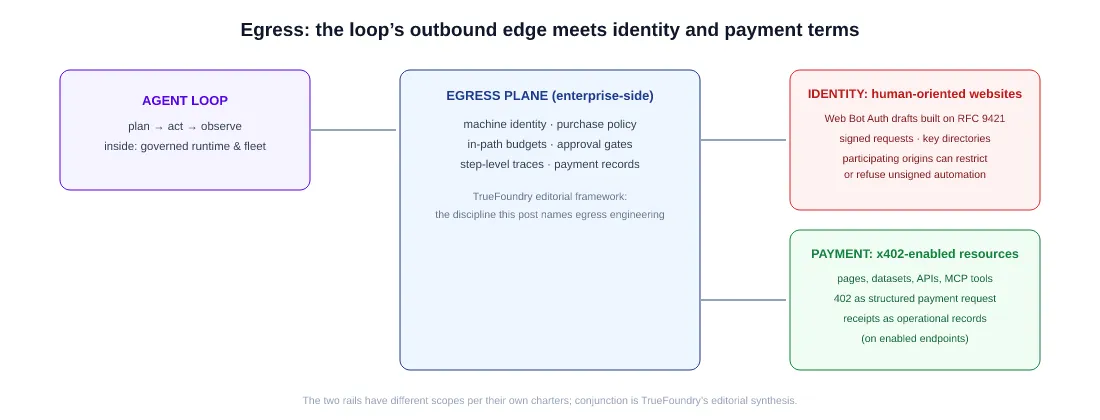
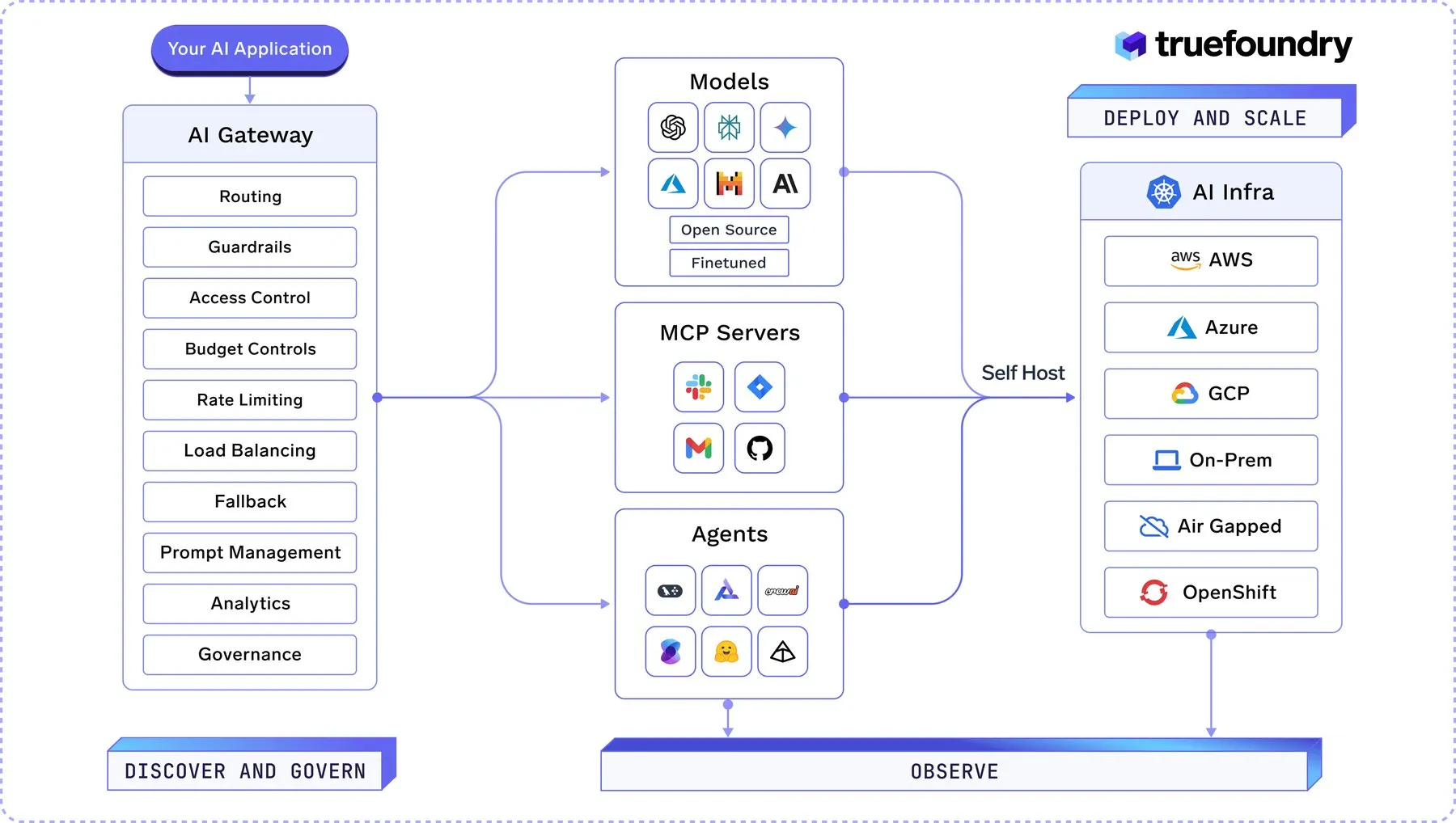
A precision note first, because this series earns its product sections by scoping them: TrueFoundry's feature set does not cover x402 settlement or Web Bot Auth request signing, as you could learn from its latest documentation. The point is narrower and structural. Whichever rails win, a governance pattern that would become more important as paid or identity-gated machine access expands — identity brokered per agent, spend bounded in-path, activity auditable per step — is the documented shape of the gateway plane TrueFoundry ships today. Identity and delegation: agents operate with brokered credentials rather than embedded keys, RBAC against the enterprise identity provider, and per-user delegation, with approval gates available on sensitive actions (Agent Harness docs; MCP Gateway auth & security). Spend enforcement: budgets scoped by tenant or team and partitionable by users, models, virtual accounts, and metadata, plus per-user, per-model, and per-application rate limits — agents and environments representable through virtual accounts or metadata where the organization adopts that mapping, with warn-only and hard-enforcement modes and budget milestone alerts (budget docs) — an in-path governance pattern that would become more important if pay-per-request resources become broadly adopted. Record: per-request cost, token, and latency attribution; per-step traces of agent runs with OpenTelemetry export; auditable records of agent and tool activity (gateway docs). And one development in Section 1 lands directly on an existing surface: Cloudflare’s announced Monetization Gateway plans to let customers charge for MCP tool calls. If paid tool access expands, an MCP gateway could become a plausible governance point for deciding which tools a fleet may call, under which identities and budgets, and with what audit record. TrueFoundry’s existing MCP Gateway provides the registry, authentication, access-control, and observability layer on which such governance could be built. Where the loop's inside was Section 5 of our first post and the fleet's controls were the second, the egress components above resolve to the same plane — deployable, for organizations whose answer to "where does this run" is strict, in VPC, on-premises, or air-gapped form (deployment posture).
Five, so the argument stays inside its evidence. Maturity varies by component. The Monetization Gateway is a waitlist, Pay Per Crawl remains a beta lineage, and Chainalysis reported more than 100 million x402 transactions on Base through Q1 2026, while noting that much of the earlier surge was driven by speculative activity and that mass adoption remained distant (chainalysis.com). The standards race is not settled. Competing protocols already exist: a Machine Payments Protocol co-authored by Stripe and Tempo (a payments network incubated by Stripe and Paradigm). This post's argument is deliberately rail-agnostic, but readers should not infer a winner. Identity adoption is early. Web Bot Auth's working group, registry drafts, and early production signers are real; universal coverage is not. And the framework is ours. "Egress engineering," the passport-and-wallet framing, and the symmetry argument are TrueFoundry's editorial synthesis, offered with sources so you can weigh them; TrueFoundry capability statements reflect public documentation at the time of writing, and Amara is an illustrative composite.
Payment-protocol security is still developing. Recent research has identified potential replay, authorization-binding, concurrency, and paid-but-denied failure modes in x402 implementations (arXiv preprint); these findings should be treated as emerging research rather than settled ecosystem-wide conclusions.
Loop engineering earned its name by taking the loop seriously as the unit of work: our first post governed its inside, our second scaled it across a fleet. Parts of the web are beginning to attach more explicit identity or payment terms to automated access. For enterprises operating agent loops, that creates a practical design question: can each loop answer the outside's two new questions without improvising — “this is who I am” and “this is the budget I act within”? Both answers are governance artifacts. Both belong to a plane, not a prompt. And both are easier to install before the first invoice than after it.
Amara and her research loop are an illustrative composite, not a specific person, organization, or incident. All statistics and quotations are as reported by the linked sources on the dates given, with quoted fragments under fifteen words and attributed; figures noted as secondary coverage are labeled as such in the text. "Egress engineering" and the passport-and-wallet framing are TrueFoundry's editorial synthesis. TrueFoundry capabilities are paraphrased from public documentation current at the time of writing — verify against live docs; TrueFoundry's documentation does not describe x402 or Web Bot Auth support, and none is claimed. TrueFoundry is not affiliated with Cloudflare, the Linux Foundation, the IETF, Amazon, or the cited publications.
TrueFoundry AI Gateway delivers ~3–4 ms latency, handles 350+ RPS on 1 vCPU, scales horizontally with ease, and is production-ready, while LiteLLM suffers from high latency, struggles beyond moderate RPS, lacks built-in scaling, and is best for light or prototype workloads.






The latest news, articles, and resources sent to your inbox

.webp)

.png)
.png)
.png)
.png)
.png)
.png)
.png)
.png)
.png)
.png)
.png)


