


.webp)
October 24, 2026
|
5 min read


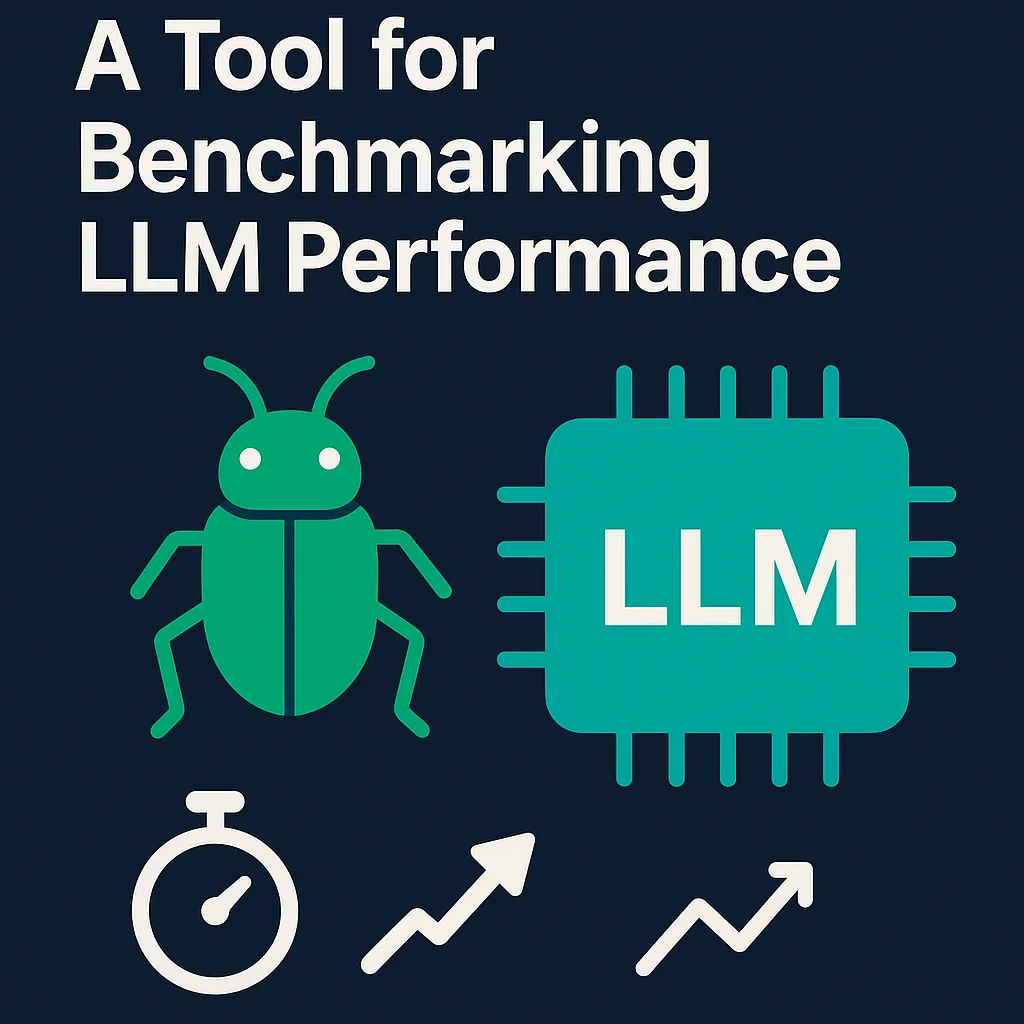
Blazingly fast way to build, track and deploy your models!
LLM Benchmarking is the process of evaluating how efficiently a Large Language Model (LLM) inference server performs under load. It goes beyond traditional performance testing by focusing on real-time response characteristics that directly impact user experience and system scalability.
Here are some of the key metrics involved:
Tracking and analyzing these metrics is critical for:
That’s where LLM Locust comes in.
As LLMs continue to power more real-time and interactive applications, benchmarking their performance accurately is more important than ever. While tools like Locust are excellent for traditional load testing, they fall short when it comes to the streaming, token-level granularity LLMs require.
Enter LLM Locust—a tool purpose-built to bridge this gap.
Let’s give credit where it’s due. Locust remains one of the most beloved tools for load testing due to its:
For standard APIs or services, it’s a fantastic choice. But for LLMs? Not quite enough.
Locust doesn’t natively track LLM-specific performance indicators, such as:
These streaming dynamics are fundamental to understanding how well an LLM performs, especially in real-time use cases.
LLM APIs often stream tokens inconsistently—some return zero tokens at first, others send one token at a time, and some deliver multiple tokens in a single chunk.
To measure output tokens accurately, responses must be re-tokenized, since the API responses can’t be trusted to follow a consistent format.
But here’s the catch: tokenization is a CPU-bound task, especially when done for every streaming response. Locust uses greenlets for lightweight concurrency, but they still operate under Python’s Global Interpreter Lock (GIL). That means CPU-heavy operations like tokenization can block the event loop, reducing throughput and skewing your benchmark results.
The combination of inconsistent streaming behavior and Python’s GIL makes this a significant performance bottleneck in traditional Locust setups.
Want to plot TTFT or streaming throughput? Locust’s UI doesn’t support custom LLM metrics out of the box, leaving key data invisible during test runs.
Tools like genai-perf are valuable, but often provide:
They lack the iterative, exploratory flexibility needed in real-world benchmarking.
LLM Locust combines the simplicity of Locust with deep support for LLM-specific benchmarking. Inspired by BentoML’s llm-bench, it introduces a modular architecture and custom frontend for real-time insights.
1. Asynchronous Request Generation
Simulated users send continuous asynchronous requests to your LLM API, mimicking real-world load. This runs on a separate python process, so there are no tokenization bottlenecks.
2. Streaming Response Collection
LLM responses are streamed and routed to a metrics daemon for lightweight parsing and analysis.
3. Metrics Processing
The daemon tokenizes responses, calculates TTFT, tokens/s, and inter-token latency, and buckets the results.
4. Aggregation
Every 2 seconds, data is sent to a FastAPI backend which mimics locust backend, which stores and aggregates metrics globally.
5. Real-Time Visualization
A customized version of Locust frontend displays:
Here is the detailed architecture:

Here is a demo of how it looks like:


Locust is a great load testing tool—but not for LLMs out of the box.
LLM Locust brings the streaming, token-level precision required to properly benchmark today’s powerful language models.
Whether you're deploying an open-source model on your own infrastructure or comparing performance across LLM APIs, LLM Locust gives you the clarity, flexibility, and control to do it right.
Github link: https://github.com/truefoundry/llm-locust
LLM Locust is an open-source benchmarking tool built on the Locust framework specifically for evaluating Large Language Models. Unlike standard load-testing tools, it measures GenAI-specific metrics like Time to First Token (TTFT) and tokens per second to ensure your models handle high concurrent traffic in production environments.
It provides deep visibility into how models behave under heavy, simultaneous loads by analyzing streaming responses and token generation rates. This data allows engineers to optimize infrastructure, identify potential bottlenecks before deployment, and ensure consistent response speeds for end users across various hardware and serving engine configurations.
Yes, but while standard Locust works for basic APIs, LLM Locust is specifically engineered for the unique requirements of generative AI. It accurately tracks streaming responses and calculates throughput across multiple concurrent requests, providing a clearer picture of how an LLM scales compared to traditional load-testing tools.
Integrating LLM Locust with platforms like Langfuse allows you to visualize performance traces during high-stress tests directly on your dashboards. You can correlate specific load patterns with model failures or latency spikes, providing deep insights into the reliability and quality of your autonomous agents under real-world pressure.
Running LLM Locust with TrueFoundry enables you to benchmark models deployed within your private cloud. You can easily test different serving engines like vLLM or TGI to find the optimal configuration for your specific hardware, ensuring your deployment is fully optimized for cost and speed.
TrueFoundry AI Gateway delivers ~3–4 ms latency, handles 350+ RPS on 1 vCPU, scales horizontally with ease, and is production-ready, while LiteLLM suffers from high latency, struggles beyond moderate RPS, lacks built-in scaling, and is best for light or prototype workloads.






The latest news, articles, and resources sent to your inbox

.webp)

.png)
.png)

.png)
.png)
.png)
.png)
.png)
.png)
.png)
.png)
.png)


