


.webp)
October 24, 2026
|
5 min read


Blazingly fast way to build, track and deploy your models!
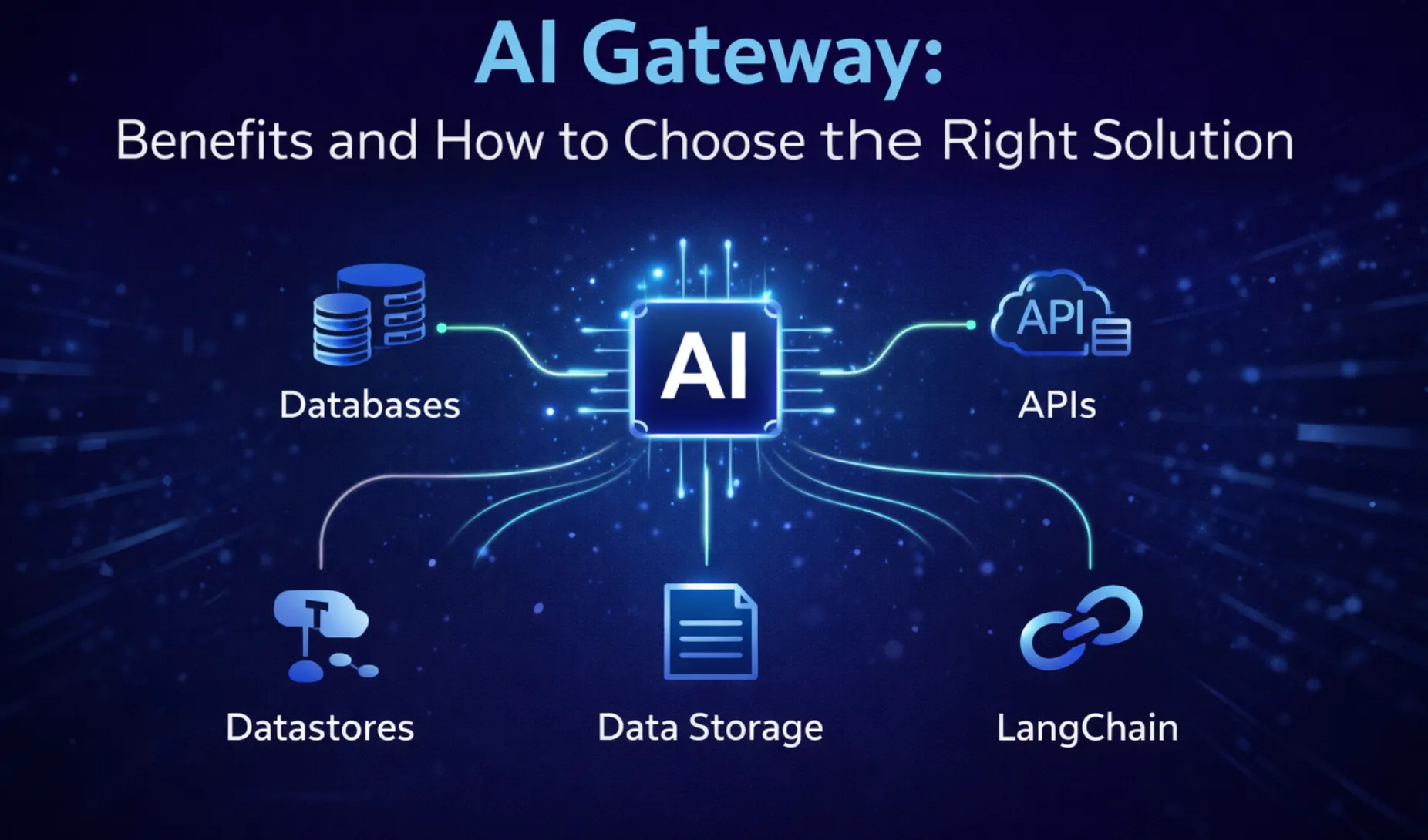
AI systems today rarely rely on a single model or provider. Most modern applications use multiple LLMs for different tasks—balancing cost, latency, accuracy, and reliability. Managing all of this directly across providers quickly becomes complex.
An AI gateway solves this by acting as a centralized control layer between your application and multiple LLM providers like OpenAI, Anthropic, Cohere, and self-hosted models. It manages routing, authentication, rate limits, caching, cost tracking, and failover in one place.
Instead of hardcoding multiple SDKs and juggling API keys across services, all requests flow through a single unified layer. This gives teams better control, visibility, and operational stability as AI usage scales.
What you'll learn in this guide
.webp)
An AI Gateway is an abstraction layer that provides unified access to multiple Large Language Models (LLMs) through a single API interface. It standardizes how applications interact with models from providers like OpenAI, Anthropic, Cohere, Together.ai, as well as open-source models such as Mistral and LLaMA deployed on private infrastructure.
At its core, an AI Gateway manages the complexity of working with multiple LLMs. It handles routing, authentication, rate limiting, observability, and cost management across different providers. Instead of integrating separate SDKs, managing multiple API keys, and dealing with inconsistent pricing and limits, teams send all requests through a single, centralized layer. This simplifies development while enabling governance and control at scale.
TrueFoundry’s AI Gateway is built for enterprise-grade performance, reliability, and observability. It enables teams to:
In addition, the gateway supports streaming and non-streaming responses, tool/function calling, prompt templates, and tagging for granular cost allocation across teams and projects. Built-in observability makes it possible to track not just performance metrics like latency and token usage, but also usage patterns, traffic trends, and endpoint-level behavior.
As organizations scale LLM usage across teams and products, an AI Gateway becomes a foundational layer for production-grade AI systems. It brings structure, visibility, and optimization to the entire lifecycle of model interactions.
If terms like API gateway and AI gateway feel easy to mix up, you’re not alone. Many teams first encounter gateways when scaling APIs, and the concepts naturally overlap. But once you move into LLM-powered systems, the requirements change significantly.
AI gateways are purpose-built for the unique complexity of Large Language Models (LLMs). Instead of just managing traffic, they also handle cost, context, and behavior—essentially bringing intelligence-aware control into the request layer.
Here’s a clear comparison between traditional API Gateways and AI Gateways:
In short, a traditional API gateway focuses on how data moves, while an AI gateway focuses on how models behave and what they cost. As LLM usage scales, AI gateways become essential for controlling spend, improving reliability, and enforcing safety across applications.
An AI gateway sits between your application and multiple LLM providers, acting as a central control layer that manages, routes, and optimizes all model requests. Instead of directly calling different APIs, every request flows through a single gateway that decides how it should be processed and where it should go.
It first provides a single entry point for all requests, standardizing prompts before forwarding them to the appropriate model. It then performs intelligent routing based on cost, latency, task type, and availability, with built-in fallback to other models if needed.
Before execution, the gateway enforces security and access controls such as authentication, authorization, and prompt safety checks like PII masking and injection protection. It can also optimize requests using caching, prompt templates, and rate limiting to improve performance and reduce cost.
Once a response is generated, the gateway processes it by normalizing outputs, logging usage, and tracking cost and latency. Throughout this flow, it continuously monitors system behavior, giving teams visibility into performance, errors, and usage patterns across all models and applications.
You need an AI gateway when working with LLMs becomes complex enough that direct API integrations start slowing down development, increasing costs, or reducing control. As soon as you move beyond a single model or a single use case, managing multiple providers, keys, and configurations manually becomes difficult to scale.
An AI gateway becomes essential when you are using multiple LLM providers and need intelligent routing, failover, or cost optimization across them. It is also useful when different teams or applications need controlled access, rate limits, and consistent security policies across shared AI infrastructure.
If you care about tracking usage, controlling spend, enforcing safety policies, or improving reliability in production AI systems, an AI gateway becomes a foundational layer. It helps standardize how models are used and ensures visibility and governance as LLM usage grows across your organization.
The increase in AI gateways is mainly in response to growing complexity. Most teams no longer use a single model from one provider. They are testing multiple models, balancing performance with cost, and supporting different use cases across teams. Without an abstraction layer, this situation can quickly become fragile and hard to manage.
Cost pressure has also had a significant impact. As AI usage grows, token consumption and latency shift from being technical issues to business concerns. AI gateways enable teams to route traffic smartly, enforce budgets, and gain insights into actual spending.
Governance is another important factor. As systems handle more sensitive data and regulated workflows, organizations require stronger controls over access, auditing, and compliance. A gateway serves as a natural point for enforcing those policies.
An AI Gateway brings a structured and scalable approach to managing LLM usage across teams and environments. Below are the key features that make it essential for modern GenAI workflows:
Unified Access: AI Gateways offer a single API interface to access multiple LLMs across vendors like OpenAI, Anthropic, or in-house models. This eliminates the need to manage individual APIs, SDKs, or keys for each provider.
Authentication and Authorization: AI Gateways enforce secure access through centralized key management. Developers receive scoped API keys while root keys remain protected, integrated with secret managers like AWS SSM, Google Secret Manager, or Azure Vault.
Role-Based Access Control (RBAC): Ensures that only authorized users can access specific models or actions, aligning with enterprise security standards.
Performance Monitoring: Track latency, error rates, and token throughput for each model endpoint. This helps detect issues early, optimize routing, and maintain SLAs.
Usage Analytics: Detailed logs and dashboards show who used which model, when, and how, offering transparency across projects and enabling cost attribution per user, team, or feature.
Cost Management: Gateways track token-level usage and associate costs with users, teams, or endpoints. This provides clear visibility into spend patterns and helps prevent cost overruns.
API Integrations: Support for external APIs and tools such as evaluation pipelines, prompt guardrails, or vector databases enables seamless integration with broader AI/ML ecosystems.
Custom Model Support: Users can bring their own fine-tuned or proprietary models into the Gateway, routing traffic alongside commercial models.
Caching: Store and reuse identical or similar LLM responses to save tokens and reduce latency.
Routing and Fallbacks: Intelligent request routing based on latency, cost, or reliability. Includes fallback mechanisms and auto-retries to improve resiliency.
Rate Limiting and Load Balancing: Supports user-level quotas, rate limiting, and load balancing across model providers for optimal throughput and stability.
Evaluating the best AI gateway solutions requires a comprehensive assessment of its capabilities across access control, model integration, observability, and cost governance. A robust AI Gateway should simplify model usage while ensuring scalability, performance, and security for production-grade applications.
.webp)
A strong AI Gateway centralizes API key management by issuing individual keys to each user or service while safeguarding root keys using secret managers like AWS SSM, Google Secret Store, or Azure Vault.
.webp)
TrueFoundry’s Gateway allows administrators to manage fine-grained access to all integrated models, whether self-hosted or third-party, via a unified admin interface. Access control configurations are tracked in versioned YAML files, ensuring auditability and compliance.
.webp)
The AI Gateway should offer a standardized interface for interacting with multiple models. TrueFoundry follows the OpenAI request-response format, making it compatible with LangChain and OpenAI SDKs. Developers can switch between models without modifying their code. TrueFoundry also provides auto-generated code snippets for different providers and programming languages, simplifying integration.
.webp)
TrueFoundry supports three key routes for model access: third-party providers (like OpenAI, Cohere, AWS Bedrock, and Anthropic), self-hosted open-source models (deployed via HuggingFace or custom infrastructure), and TrueFoundry-hosted models shared across clients. This flexibility enables teams to mix and match models based on use case, budget, or latency requirements.
.webp)
To ensure reliability, the Gateway should monitor latency, error rates, throughput, and inference failures. TrueFoundry captures key metrics like request latency, rate of tokens, and rate of inference failures, making it easy to identify performance bottlenecks through real-time dashboards.
.webp)
Understanding how, when, and by whom models are used is critical for governance. TrueFoundry logs detailed request and response activity, token consumption, and cost per model. These insights help teams manage workloads and optimize usage patterns.
.webp)
The Gateway should log costs from all model interactions, whether hosted internally or through commercial APIs. TrueFoundry provides full visibility into model usage costs across users, teams, and projects. Integrated dashboards allow organizations to track spend, configure alerts, and apply rate limits or budget caps to control overages.
Advanced features in an AI Gateway determine how effectively it can operate in real-world, production-scale environments. TrueFoundry’s AI Gateway brings a rich set of capabilities that optimize performance, improve reliability, and seamlessly integrate with broader systems, making it enterprise-ready from day one.
Caching helps reduce latency and save costs by avoiding redundant model calls. TrueFoundry supports both exact match caching (for identical prompts) and semantic caching (for similar meaning queries), which enhances speed without compromising on relevance. You can configure cache expiration policies and manually invalidate outdated entries when needed. This ensures that the gateway serves fast, accurate, and up-to-date responses.
For production-critical applications, the gateway automatically routes traffic to alternative models if the primary one fails, ensuring uninterrupted service. Automatic retries help recover from transient errors without user intervention. Built-in rate limiting helps enforce quotas and prevent overuse, while load balancing distributes traffic across multiple models or providers to maintain optimal throughput and minimize latency.
.webp)
TrueFoundry’s Gateway supports tool calling by simulating interactions with external APIs. While the actual function is not executed by the gateway, the model can return structured outputs representing the intended tool call. This is ideal for building workflows where LLMs need to decide when and how to invoke tools, enabling developers to design and test these behaviors safely.
Tool Simulation: Structured output for modeled API/function calls, without actual execution.
Modern applications often involve more than just text. The Gateway supports multimodal inputs such as text and images within the same request, which unlocks use cases like document Q&A, visual search, or customer support enriched with screenshots or product photos. This makes the AI Gateway suitable for both traditional NLP and next-gen AI applications that require context from multiple data formats.
TrueFoundry enables deep integration with your existing stack. You can plug in observability tools like Prometheus and Grafana for real-time monitoring, implement safety layers using Guardrails AI or NeMo Guardrails, and evaluate model quality continuously using Arize or MLflow. This connected ecosystem ensures that your AI system is not just performant, but also safe, transparent, and continuously improving.
An AI Gateway delivers significant operational, financial, and engineering advantages for organizations integrating large language models (LLMs) into their products and workflows. It acts as a control plane for AI consumption, providing a consistent interface, enforcing security, and optimizing performance at scale.
When multiple teams or applications need to interact with different LLM providers, managing individual keys, tokens, and access rights becomes complex. An AI Gateway centralizes access control, enabling role-based permissions, audit logging, and secure key management.
Example: A global enterprise deploying AI features across marketing, product, and support teams uses an AI Gateway to assign scoped API keys and restrict each team’s access to specific models, reducing the risk of accidental misuse or data leakage.
LLMs can become a significant operational cost, especially with growing usage across teams. AI Gateways provide fine-grained cost tracking by user, team, or project. This visibility helps organizations manage budgets, identify inefficiencies, and introduce chargeback models where appropriate.
Example: A SaaS company offering AI-powered features to its customers monitors usage via the gateway and uses the data to implement tiered pricing based on actual token consumption.
The unified API layer allows organizations to swap LLMs or providers without modifying application code. This makes it easier to test new models, negotiate better pricing, or shift from commercial to open-source deployments.
Example: A startup initially using a commercial LLM transitions to a fine-tuned open-source model for data privacy and cost savings, without changing their codebase, thanks to the gateway abstraction.
Gateways offer built-in fallbacks, automatic retries, caching, and load balancing to ensure uninterrupted service and consistent performance, even under load or during provider outages.
Example: A high-traffic chatbot system handles sudden traffic spikes by dynamically routing requests across multiple providers while falling back to cached responses when needed.
For regulated industries, the ability to track and audit model usage is critical. AI Gateways integrate with monitoring, logging, and security tooling to meet compliance standards and internal governance policies.
Example: A healthcare company logs every request and response through the gateway, enabling complete traceability for audit purposes while maintaining data access boundaries.
AI gateways can be deployed in different ways depending on scale, latency needs, security requirements, and infrastructure design. Each model fits a different stage of AI maturity, from simple setups to highly distributed enterprise systems.
In a global deployment, a single AI gateway manages traffic across all regions. This setup simplifies management and provides a unified control plane, but may introduce latency for geographically distributed users.
Here, gateways are deployed within specific geographic or regulatory zones. This helps meet compliance requirements like data residency while keeping traffic local to each region for better performance.
In this model, dedicated gateway instances are allocated per team, application, or tenant. It ensures isolation, predictable performance, and better control over resource usage and cost allocation.
These deployments route requests across multiple cloud providers and LLM vendors. They reduce dependency on a single provider and enable better cost, performance, and reliability optimization.
Micro-gateways are lightweight instances placed closer to applications or services. They reduce latency and allow fine-grained control at the service or workload level, especially in distributed architectures.
This setup uses a central global gateway combined with regional or local gateways. The top layer handles policy and governance, while lower layers manage execution and routing closer to workloads.
In a sidecar model, the gateway runs alongside each application instance, typically within the same environment or container. This allows ultra-low latency communication and tightly coupled request handling for microservices-based architectures.
An AI gateway acts as a central enforcement layer for governance across all LLM usage in an organization. As teams scale AI applications, it becomes difficult to track how models are used, what data is being sent, and how much each request costs. The gateway solves this by enforcing consistent policies across every interaction with an LLM.
It helps define and enforce access control policies, ensuring only approved users, services, or teams can access specific models or capabilities. This reduces unauthorized usage and ensures AI systems follow organizational security standards.
It also plays a key role in data governance and compliance by applying safeguards such as PII masking, prompt filtering, and audit logging. This ensures sensitive information is not exposed to external models and that every request can be traced for compliance audits.
From a financial and operational perspective, the gateway enables cost governance and usage tracking. It provides visibility into token consumption, model spend, and team-level usage, helping organizations prevent uncontrolled AI costs.
Overall, an AI gateway becomes the foundation of AI governance by bringing together security, compliance, access control, and cost management into a single, enforceable layer across all LLM interactions.
TrueFoundry’s AI Gateway is designed for teams that want to move fast with LLMs without losing control over performance, cost, or security. Instead of stitching together multiple tools for routing, observability, and governance, it provides a single unified control plane for managing all LLM traffic across providers and models.
One of its key strengths is performance at scale, with low-latency routing and efficient request handling that keeps AI applications responsive even under heavy load. It is built to support production-grade workloads where reliability and speed are critical.
It also offers strong observability and cost tracking, giving teams clear visibility into token usage, latency, errors, and spend across users and services. This makes it easier to optimize model usage and avoid unexpected cost spikes.
On the governance side, TrueFoundry enables fine-grained access control, rate limiting, and policy enforcement, helping organizations secure AI usage across teams while staying compliant with internal standards.
Overall, TrueFoundry is a strong choice for organizations that need a scalable, secure, and production-ready AI gateway that unifies routing, monitoring, and governance in one platform.
As organizations scale their use of large language models, the need for a secure, reliable, and efficient interface becomes critical. An AI Gateway serves as that foundational layer, abstracting away the complexity of managing multiple providers, enforcing access controls, tracking costs, and ensuring performance at scale. It empowers teams to experiment, deploy, and monitor LLM-powered applications with confidence and control.
Whether you're building internal copilots, customer-facing chat interfaces, or multimodal AI workflows, an AI Gateway helps standardize infrastructure while remaining flexible enough to support evolving model ecosystems. Features like caching, routing, cost attribution, and tool calling further extend its value for enterprise-grade deployments.
In a rapidly changing AI landscape, adopting an AI Gateway is not just a convenience; it’s a strategic investment in operational maturity, observability, and long-term scalability.
Ready to see these capabilities in action? Book a demo with TrueFoundry today to learn how we can centralize and secure your enterprise AI infrastructure.
TrueFoundry AI Gateway delivers ~3–4 ms latency, handles 350+ RPS on 1 vCPU, scales horizontally with ease, and is production-ready, while LiteLLM suffers from high latency, struggles beyond moderate RPS, lacks built-in scaling, and is best for light or prototype workloads.




An AI gateway manages and routes requests between applications and multiple LLM providers. It handles authentication, cost tracking, caching, rate limiting, and observability, ensuring secure, optimized, and scalable access to AI models through a single unified interface.
The best AI gateway depends on use case. TrueFoundry, Azure AI Gateway, and other enterprise platforms stand out for scalability, governance, and performance. The ideal choice balances security, latency, cost control, integrations, and developer experience.
A traditional API gateway manages traffic between microservices, focusing on routing and authentication. An AI gateway goes further by managing LLM-specific needs like token usage, model routing, semantic caching, prompt safety, cost optimization, and AI observability.
An AI firewall focuses on security, blocking threats, prompt injections, and sensitive data leaks. An AI gateway manages the full lifecycle of LLM requests, including routing, cost control, observability, and governance, with security as one component.
If you use a single LLM provider, an AI gateway is optional but still useful. It adds observability, cost tracking, caching, and security layers. However, its full value becomes more important when managing multiple models or scaling usage.
TrueFoundry AI Gateway helps enterprises by unifying LLM routing, observability, and governance in one platform. It improves performance, reduces cost, enforces access control, and provides real-time monitoring, making large-scale AI adoption secure, efficient, and production-ready.



The latest news, articles, and resources sent to your inbox

.webp)

.png)
.png)
.png)
.png)
.png)
.png)
.png)
.png)
.png)
.png)
.png)


