


.webp)
October 24, 2026
|
5 min read


Blazingly fast way to build, track and deploy your models!
As AI agents become more capable, developers are moving beyond simple chatbots to systems that can plan, reason, use tools, and complete complex tasks autonomously. Building these workflows from scratch, however, requires significant orchestration and state management.
LangChain Deep Agents simplifies this process. Built on top of LangGraph, it provides a higher-level abstraction for creating long-running, multi-step AI agents with less boilerplate. Instead of manually orchestrating planners, memory, tool calls, and execution loops, developers can use Deep Agents to build sophisticated agent workflows more quickly.
In this guide, we'll explain what LangChain Deep Agents are, how they work, their key features, how they compare with LangGraph, and when they're the right choice for building production AI agents.
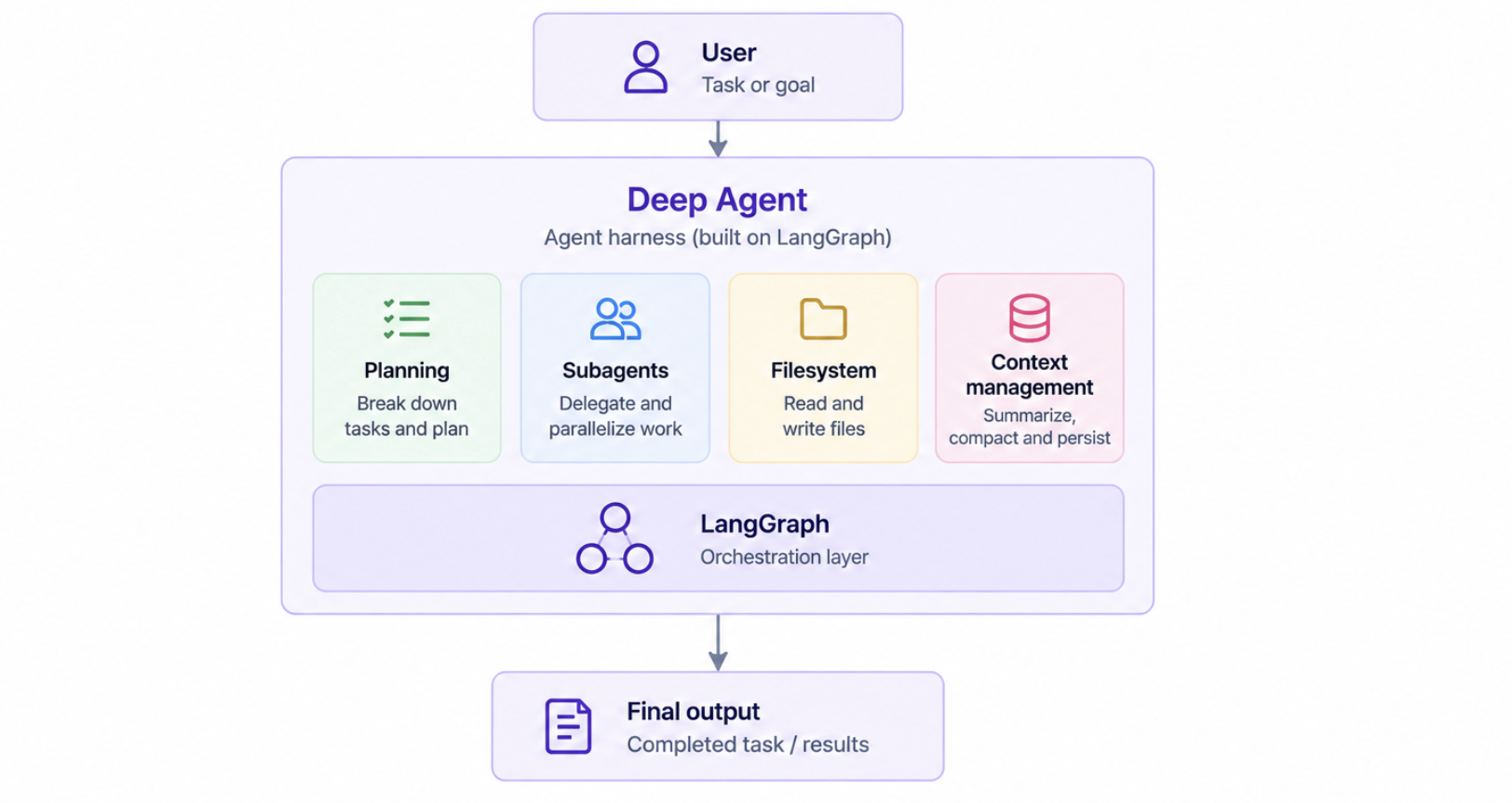
LangChain Deep Agents is an open-source library from LangChain for building AI agents that can handle long-running, multi-step tasks with minimal orchestration code. Rather than manually implementing planning, task decomposition, file management, and tool execution, Deep Agents packages these capabilities into a higher-level abstraction.
Under the hood, Deep Agents is built on LangGraph. It uses LangGraph's stateful execution engine while adding opinionated patterns for agent planning and execution. This means developers can benefit from LangGraph's durability and workflow management without building every component themselves.
Deep Agents is designed for tasks that require an agent to:
Instead of replacing LangChain or LangGraph, Deep Agents sits on top of them. LangChain provides integrations with models and tools, LangGraph manages execution and state, and Deep Agents provides a higher-level interface for common agentic workflows.
LangChain Deep Agents includes several capabilities that simplify building production-ready AI agents:
These features make Deep Agents particularly useful for workflows such as coding assistants, research agents, document generation, and other tasks that require more than a single LLM call.
Deep Agents follows a structured workflow that helps AI agents tackle complex tasks more reliably than a single prompt-response interaction.
A typical execution looks like this:
This planning-and-execution approach enables agents to tackle workflows that would be difficult to complete in a single LLM call.
Although they're closely related, Deep Agents and LangGraph solve different problems.
LangGraph is a general-purpose orchestration framework that gives developers complete control over agent workflows. Deep Agents builds on top of LangGraph by providing a higher-level, opinionated implementation for common agent patterns.
If you need complete flexibility over your agent architecture, LangGraph is the better choice. If you want to build sophisticated agents without implementing common orchestration patterns yourself, Deep Agents can help you get started more quickly.
LangChain Deep Agents makes it significantly easier to build long-running AI agents, but it isn't a complete production platform. Teams evaluating it for enterprise deployments should be aware of a few tradeoffs.
Credential governance across many agents, not one. Model access in create_deep_agent() is a single string, model-agnostic across providers, but with no RBAC, no per-team budget, and no centralized place to say "only the finance team's agents can call this model" or "cap spend at $500 a month for this agent." MCP tool credentials are handled however you wire them into your own environment. There's no equivalent of a gateway that centralizes OAuth, rotates tokens, and delegates access per user across every agent that needs it. Multiply that across a dozen agents built by different teams and you're either building that governance layer yourself or living without it.
Multi-team access control that isn't just filesystem permissions. Deep Agents' permission model is genuinely well designed for what it covers: declarative allow/deny rules over which paths an agent can read or write. But that's a different kind of control than governing which team can use which model, which MCP server, or which skill. A platform team supporting agents across multiple groups needs identity-and-team-scoped access control, not just path-scoped file access.
Cost visibility per agent, not per trace. Prompt caching is handled well (automatic on Anthropic and Bedrock models), and tracing runs through LangSmith. But LangSmith's tracing is built around inspecting individual runs, not a fleet-wide FinOps view of what each of twenty agents is costing per day, per team, per model. Once you're running enough agents that budget overruns are a real risk, "here's a trace" and "here's a dashboard broken out by agent and by team" are different tools.
Deployment options that stop at self-hosted or a single managed cloud. You either run Deep Agents entirely yourself, or deploy through LangGraph Platform hosting starting from $35/month. Neither path currently offers an on-prem or air-gapped option, which matters the moment a regulated industry or a strict data-residency requirement enters the picture.
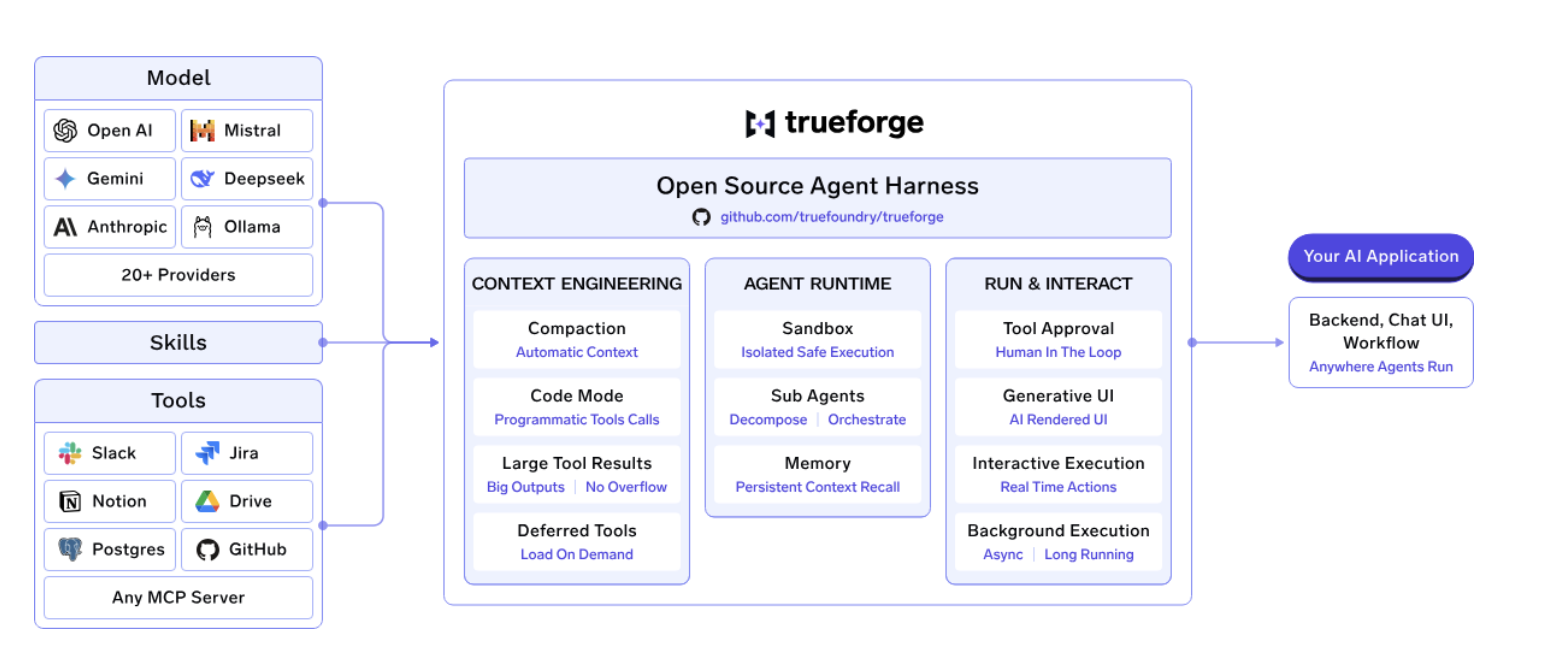
LangChain Deep Agents solves much of the hard work inside an individual agent, including planning, subagents, filesystem tools, skills, memory, and long-running execution. But once you're running agents across multiple teams, the problem shifts from building the agent to operating the fleet.
TrueForge is TrueFoundry's open-source, vendor-neutral agent harness for that runtime layer. It runs the agent loop around the model, including planning, tool calls, context management, approvals, and session state, while letting you bring your own models, MCP servers, and sandbox providers.
You can run it locally with npx @truefoundry/trueforge, or deploy the same harness for a team using Docker Compose or Helm. See the TrueForge documentation.
TrueForge also provides several mechanisms for controlling the amount of context and tool data that reaches the model.
Deferred tool loading means MCP tool schemas load on demand instead of filling the window upfront. Code Mode lets the agent chain several tool calls inside one sandbox script, so only the printed summary enters context rather than every intermediate result. Oversized tool responses get offloaded to a sandbox file and replaced with a path and a preview. Compaction fires at 80% of the model's context length and swaps old history for a structured summary, which is the direct answer to replay. Subagents run with their own clean context and hand back only the result.
The sandbox model is the other lever. Most harnesses wrap the entire session in a container. TrueForge treats the sandbox as a tool and spins one up only when the agent actually needs to execute code, so one server runs many agents at once and turns that never touch code stay cheap.
TrueForge is also structured as a runtime rather than only a library interface.
The core server runs the agent loop and provides streaming, approval gates, subagent delegation, compaction, and persistent sessions. An HTTP API and TypeScript SDK (@truefoundry/trueforge-sdk) expose the same capabilities programmatically. A separate chat UI and UI SDK (@truefoundry/trueforge-ui) can be used directly, themed, or embedded into another product.
This gives teams a deployment surface beyond the Python agent definition itself: the same runtime can power an application, API, or embedded agent experience.
Models, MCP servers and sandbox providers are all bring-your-own. When a cheaper model ships you point at it instead of rewriting the agent, which is how the same benchmark run on GLM-5.2 solved the same ~11 of 14 tasks for $2.90 per run.
The difference between an agent framework and an agent runtime becomes clearer when you compare them on the same workloads. TrueFoundry benchmarked TrueForge and Deep Agents on DevRev's Enterprise-Bench, which consists of 14 cross-system enterprise tasks. Each task requires the agent to plan, call MCP tools across a CRM, project tracker, and document store, combine the results, and return an answer that meets the evaluation rubric. Both harnesses ran the same tasks with the same MCP servers, and answers were scored by a blind LLM judge.
With Opus 4.8 held constant, the two harnesses produced similar task accuracy, but their execution costs were different:
The benchmark shows a relatively small difference in task accuracy, but a much larger difference in execution cost. TrueForge used less than a quarter of the tokens used by Deep Agents and was roughly 2.5x cheaper per run on the same model.
The difference comes largely from how the two runtimes handle orchestration and context. Deep Agents provides capabilities such as planning, a virtual filesystem, and subagents, but these can also add more orchestration and context to each turn. TrueForge takes a leaner approach, using targeted tool calls and context compaction to avoid repeatedly sending large histories and tool responses back to the model. This matters because the cost of an agent is not determined by the model price alone. Two agent systems running the same model can have very different token consumption depending on how they implement planning, tool use, context management, and subagents.
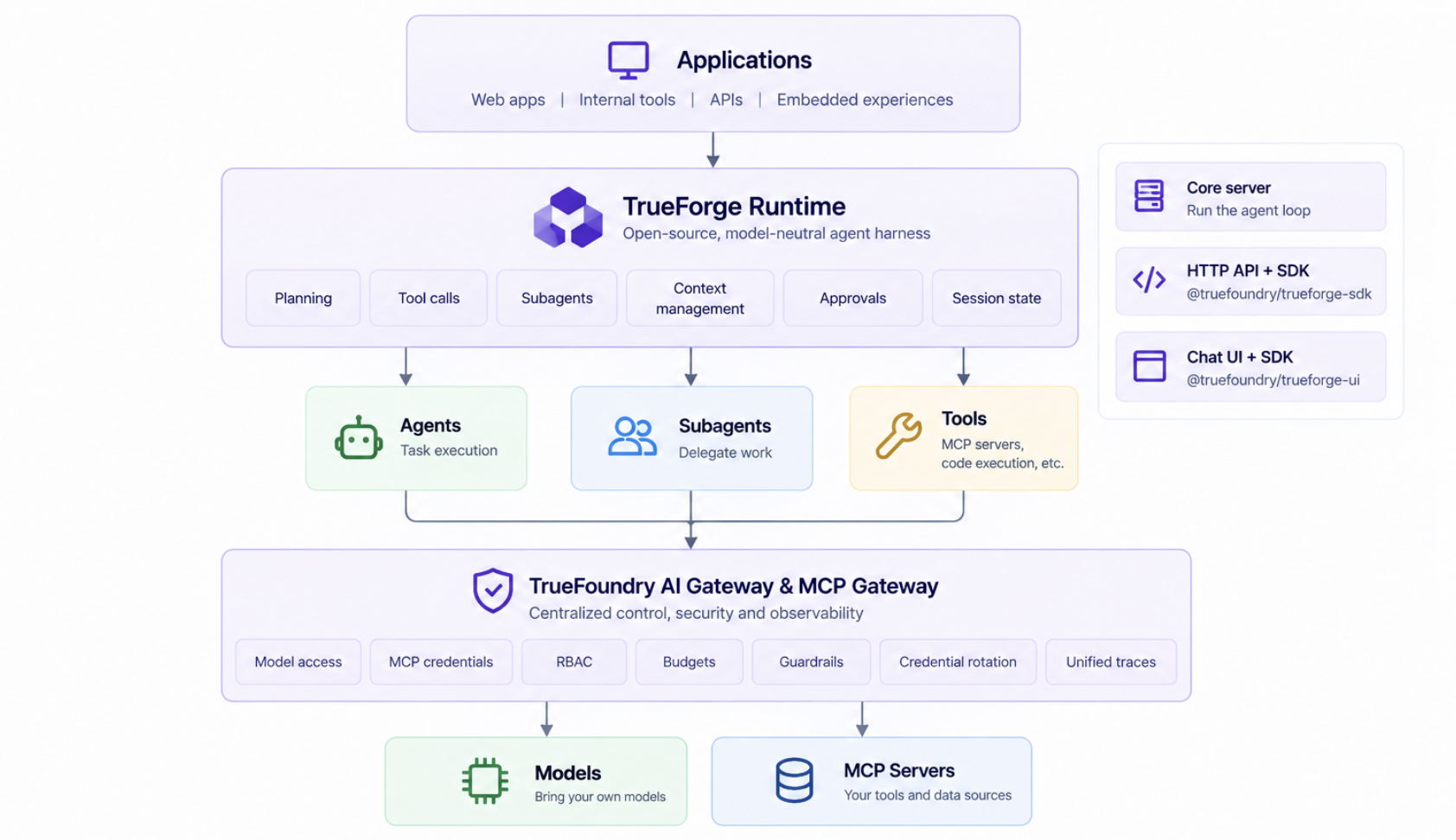
TrueForge can also connect to TrueFoundry's AI Gateway and MCP Gateway to provide the controls that become important once agents are no longer isolated projects, including centralized model access, MCP credentials, RBAC, budgets, guardrails, credential rotation, and unified traces. This moves those concerns out of individual agent definitions and into a shared platform layer.
For teams evaluating Deep Agents for production, the benchmark is a useful reminder that the framework is only one part of the stack. The runtime architecture around the agent can have a significant impact on token usage, latency, and cost. TrueForge is designed to provide that runtime layer while keeping the model and infrastructure choices open.
Deep Agents makes it significantly easier to build sophisticated agents by packaging capabilities such as planning, subagents, skills, memory, and filesystem tools on top of LangGraph. For developers building individual agents, that higher-level abstraction can remove a lot of implementation work.
The production problem is different. Once agents move beyond individual projects, teams need to manage models, tools, credentials, execution environments, approvals, observability, and costs across multiple workloads. Those concerns sit outside the core agent loop and can require a substantial amount of additional infrastructure.
TrueForge takes a runtime-first approach to this problem. It provides an open-source, model-agnostic agent harness with the agent loop and the surrounding production capabilities needed to operate agents, while still allowing teams to choose their models, MCP servers, and deployment environment.
The choice ultimately comes down to how much of the production stack you want to own. Deep Agents is a strong option for building sophisticated agents and customizing the agent logic yourself. TrueForge is designed for teams that want to move from building agents to operating them reliably at scale.
Yes. LangChain Deep Agents is released under the MIT License, making it open source. While the framework is free to use, managed deployment through LangSmith is a commercial offering.
Deep Agents provides a robust open-source agent harness, but organizations may still need additional capabilities such as centralized credential management, model governance, cost controls, and platform-wide observability. These concerns are outside the core scope of Deep Agents and are typically addressed by an enterprise AI platform.
Deep Agents handles the individual agent loop well: filesystem tools, subagents, planning, skills, and memory. What it doesn't include is centralized credential governance across many agents, team-scoped access control, and fleet-wide cost tracking, all of which become necessary once more than one team is building agents on top of it.
If your primary goal is building agent workflows with an open-source framework, Deep Agents is an excellent choice. However, if you need enterprise-grade governance, centralized credential management, model-level RBAC, observability, and flexible deployment across SaaS, self-hosted, VPC, or on-premises environments, TrueFoundry Agent Harness provides a more comprehensive production platform.
Yes. The platform is OpenTelemetry-compliant and plugs into Grafana, Datadog, Prometheus, or your existing stack, tracing every request from prompt through tool and model execution.
TrueFoundry AI Gateway delivers ~3–4 ms latency, handles 350+ RPS on 1 vCPU, scales horizontally with ease, and is production-ready, while LiteLLM suffers from high latency, struggles beyond moderate RPS, lacks built-in scaling, and is best for light or prototype workloads.






The latest news, articles, and resources sent to your inbox

.webp)

.png)
.png)
.png)
.png)
.png)
.png)
.png)
.png)
.png)
.png)
.png)


