October 24, 2026
|
5 min read


Blazingly fast way to build, track and deploy your models!
AI agents can do more than generate responses. They can query databases, create tickets, call APIs, update records, and coordinate with other agents to complete a task. But as these systems gain access to enterprise resources, one security question becomes harder to ignore: how do you know which agent performed an action, whose request it was acting on, and whether it had permission to do so?
Most authentication systems were designed around human users and applications. AI agents do not fit neatly into either category. An agent can act autonomously, choose tools at runtime, and execute multiple operations on behalf of different users. Giving it a human user's credentials or a shared service account makes it difficult to track and control those actions.
This is where AI agent identity comes in. It gives every registered agent a verifiable identity, allowing security teams to authenticate the agent, define its permissions, and trace its actions without losing sight of the person or service behind a request.
This guide explains what AI agent identity is, how it differs from traditional non-human identities, and how to implement it across enterprise AI systems.
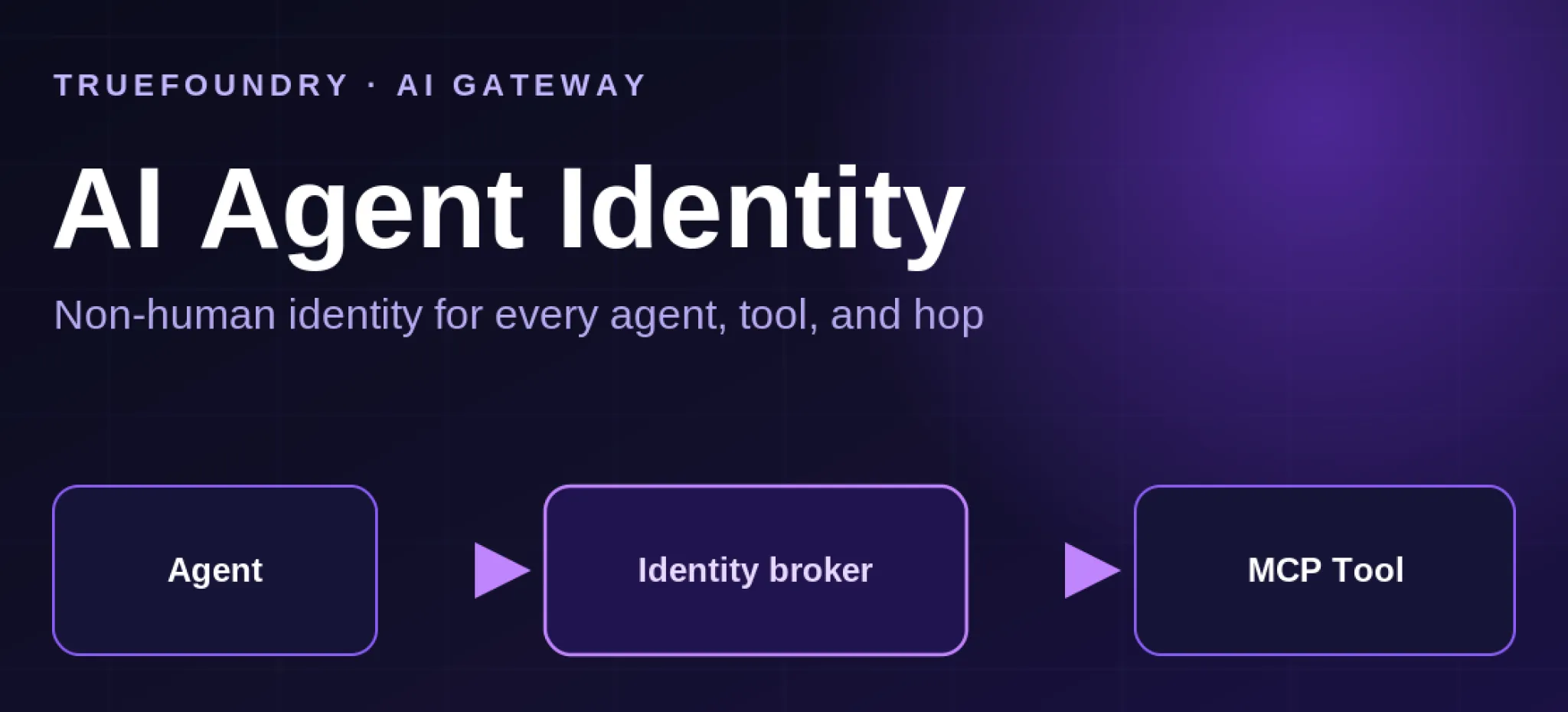
AI agent identity is the verifiable credential a registered agent presents on every call it makes. It answers a question tokens alone cannot: not "was a valid credential presented" but "which agent is calling, and who is it acting for right now."
TrueFoundry already recognizes two kinds of principal, and an agent identity is a third.
The line that matters is delegation. A virtual account can only ever act as itself, so point one at an MCP server and every call looks the same no matter who prompted it. An agent identity can act on behalf of someone else, so a single registered agent that serves hundreds of people still makes calls that stay attributable to whoever each request is for, while remaining identifiable as the agent. That is the property that makes agent traffic auditable.
Human identity, service identity, and agent identity serve different purposes, even when they interact within the same workflow.
Consider an employee asking an AI agent to investigate a production issue. The agent queries an internal database, retrieves a Jira ticket, and prepares a suggested fix. The employee's identity establishes who initiated the task. The agent's identity establishes which agent performed the tool calls. Delegation context connects those actions to the employee's request.
Without this separation, logs may identify only the employee or a shared service account, leaving security teams without a reliable way to distinguish the agent responsible for an action.
An AI agent identity needs more than a name or identifier. It must provide enough information to establish the agent's identity, determine whether it can access a resource, and maintain accountability across delegated requests.
Depending on the identity implementation, this can include:
Not every implementation carries all these fields in the same token. Some information may live in the agent registry or be supplied through a separate authorization mechanism.
The important requirement is that authentication and authorization work together. A valid credential establishes identity; it does not automatically grant access to every resource. The system must also check the agent's permissions and, where delegation is involved, the authority associated with the originating request.
Giving each agent a distinct identity is one decision that unlocks the whole governance model.
That last point is the quiet payoff. Once identity is required to act, the registry stops being documentation and becomes the chokepoint that makes every other control possible.
AI agent identity works through a series of steps that establish which agent is making a request, verify its identity, determine what it can access, and track the actions it performs. These steps connect identity with access control throughout an agent's workflow.
Identification assigns each registered agent a distinct identity. This identity connects the agent to its registration details, owner, and intended purpose. When a request reaches a protected resource, the system can use this identifier to determine which agent is making the call.
Authentication verifies that the agent is who it claims to be. Depending on the implementation, the agent may present a signed token or another supported credential. The receiving system validates the credential and checks relevant claims, such as issuer and audience, before accepting the request.
Authorization determines what the authenticated agent is allowed to do. Policies can restrict access to specific models, APIs, MCP servers, tools, or data. A valid identity does not automatically grant permission; the system must evaluate the requested action against the applicable access rules.
Delegation allows an agent to act on behalf of a user or another service without losing its own identity. The system evaluates the agent's authority alongside the delegated context to determine whether the requested action is permitted. This helps preserve accountability when one agent serves multiple users.
Audit and enforcement ensure that identity and access policies apply throughout the workflow. Gateways can validate requests, enforce permissions, and record relevant activity. Audit logs should connect actions to the agent and, where available, the originating user. Security teams can use these records to investigate incidents, review access, and revoke compromised identities.
AI agents use enterprise credentials to access tools, APIs, and sensitive data. Without proper identity controls, they can misuse permissions, follow malicious instructions, or operate without oversight.
Agents may receive broader permissions or long-lived API keys than their tasks require. If compromised, these credentials can expose sensitive systems.
How to reduce these risks: Apply least-privilege access, restrict credentials to specific resources, use short-lived tokens where supported, and review permissions regularly.
Agents using shared service accounts or human credentials can inherit excessive access. This also makes it harder to identify which agent performed an action.
How to reduce these risks: Assign each agent a distinct identity. Evaluate the agent's permissions separately from the user's permissions, and restrict delegated access to what the task requires.
Malicious instructions hidden in emails, documents, or webpages can trick authenticated agents into misusing their legitimate permissions to perform unauthorized actions.
How to reduce these risks: Treat external content as untrusted, validate tool calls, enforce authorization outside the model, and require human approval for sensitive operations.
Forgotten or unapproved agents may retain active credentials after their original purpose ends, leaving enterprise resources exposed without clear ownership or oversight.
How to reduce these risks: Maintain a central agent registry, assign clear ownership, review inactive agents regularly, and revoke credentials when agents are retired.
Weak authentication between agents can allow rogue agents to impersonate trusted workloads or interfere with delegated tasks, potentially exposing data or triggering unauthorized operations.
How to reduce these risks: Authenticate each agent with verifiable credentials, validate token claims, and authorize agent-to-agent requests before allowing access to tools or resources.
An agent's behavior may change as its instructions, tools, or environment evolve. Without runtime monitoring, it can perform actions outside its intended role while using valid credentials.
How to reduce these risks: Monitor tool calls and access patterns, alert on unusual activity, review permission changes, and enforce fixed authorization policies regardless of the agent's decisions.
AI agents rely on tools and other agents to complete tasks, making identity verification important at every connection. The Model Context Protocol (MCP) standardizes how agents connect to external tools and data sources, while agent-to-agent communication allows agents to delegate work to one another.
In both cases, identity helps establish who is making a request and whether that caller is authorized to perform the requested action.
With MCP, an agent connects to an MCP server to access tools, resources, or prompts. Authentication identifies the caller, while authorization determines which operations it can perform. An MCP gateway can enforce these policies centrally, helping prevent unregistered agents from accessing protected tools.
Agent-to-agent communication introduces another layer of delegation. When one agent asks another to perform a task, the receiving agent needs to verify the calling agent's identity and check the permissions associated with the request. Where the task involves a user, the system should preserve that delegation context rather than treating the first agent's access as unrestricted authority.
A secure implementation should authenticate each participant, validate credentials and permissions at every trust boundary, and maintain audit records for delegated actions. This allows teams to trace activity across MCP tool calls and multi-agent workflows without relying on shared credentials or blindly trusting one agent because another agent invoked it.
Zero trust security follows a simple principle: never trust a request solely because it comes from an internal system or an authenticated user. Every request must be verified and authorized. AI agent identity applies this principle to autonomous agents accessing enterprise tools, APIs, and data.
A distinct identity for each agent helps enforce zero trust in several ways:
For example, an AI agent may be authorized to read Jira tickets but not delete them. Even if the agent has a valid identity, a request to delete a ticket should be denied unless its permissions explicitly allow that action.
With agent identity and gateway-level enforcement, organizations can apply zero-trust policies consistently across AI agents, MCP servers, and connected enterprise services.
No single standard currently covers every aspect of agent identity, delegation, authorization, and auditing.
The key standards and frameworks include:
On TrueFoundry, an agent identity is not a separate object you create and bolt on. It is a step in registering the agent, so the identity and the agent are one to one. Register the agent and its identity comes into being. Delete the agent and the identity goes away with it.
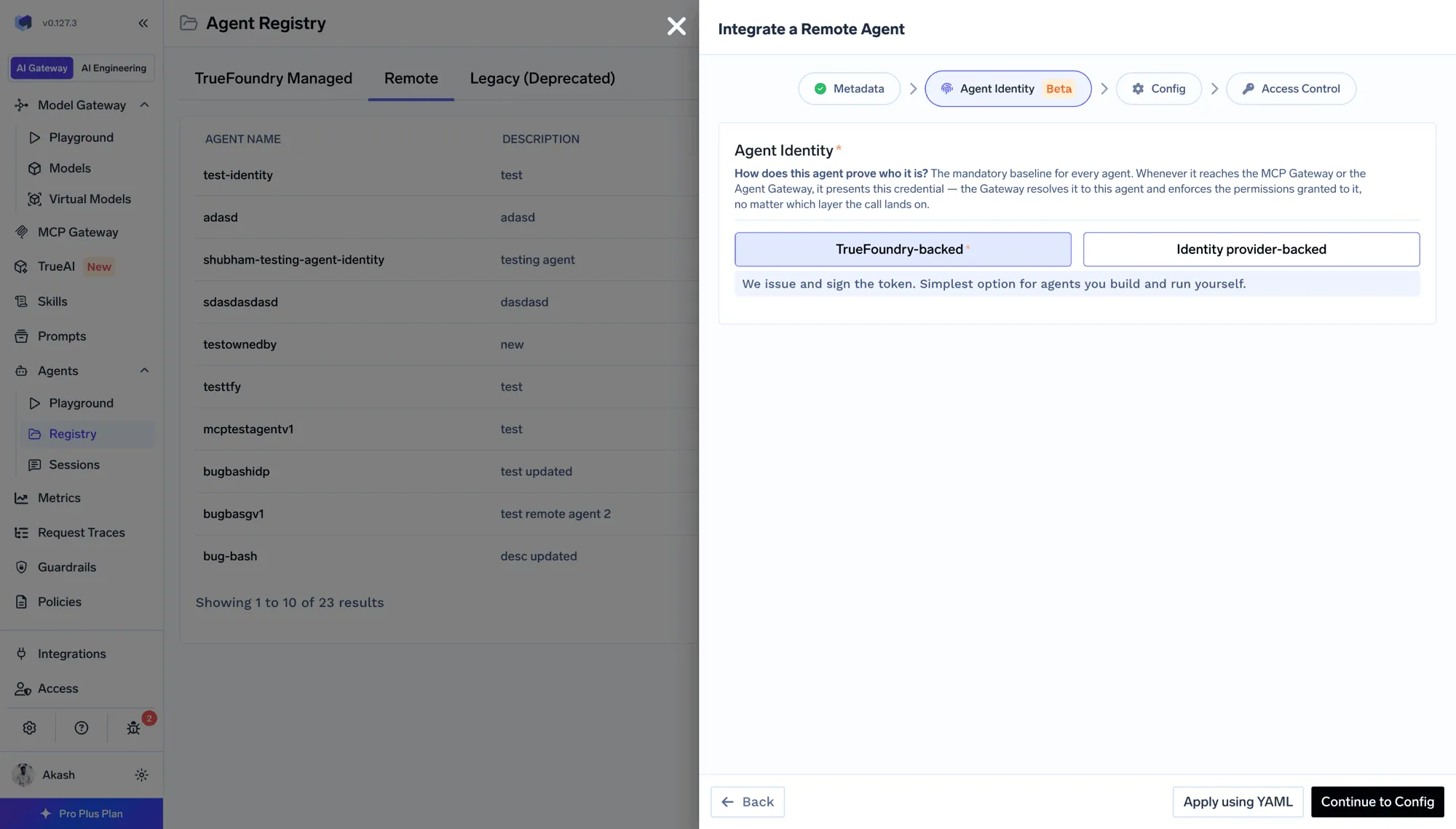
During registration you choose how the agent proves who it is:
The identity means the same thing either way. Only the issuer differs, and you can mix issuers per agent inside one tenant.
When your identity provider has no agent-identity capability yet, TrueFoundry can play all three control-plane roles. It issues each agent's identity, authorizes every call at the Agent Gateway and MCP Gateway, and, with token exchange, mints a scoped credential for each hop. Your enterprise SSO keeps doing what it already does, which is authenticating human users. On a call, the agent presents its own identity alongside the user's, so both are visible at the same time:
curl https://gateway.truefoundry.ai/api/llm/chat/completions \
  -H "Authorization: Bearer $USER_TOKEN" \
  -H "x-tfy-agent-authorization: $AGENT_TOKEN" \
  -H "Content-Type: application/json" \
  -d '{
        "model": "openai-main/gpt-4o",
        "messages": [{"role": "user", "content": "Summarize my open issues"}]
      }'
The agent fetches its own token from the registry (the Get Token action on the agent), the same way a virtual account does.
Delegation is not unbounded. It is scoped by the agent's collaborators, set on the Access Control step of registration. The same list that decides who may invoke the agent also decides who the agent may act for.
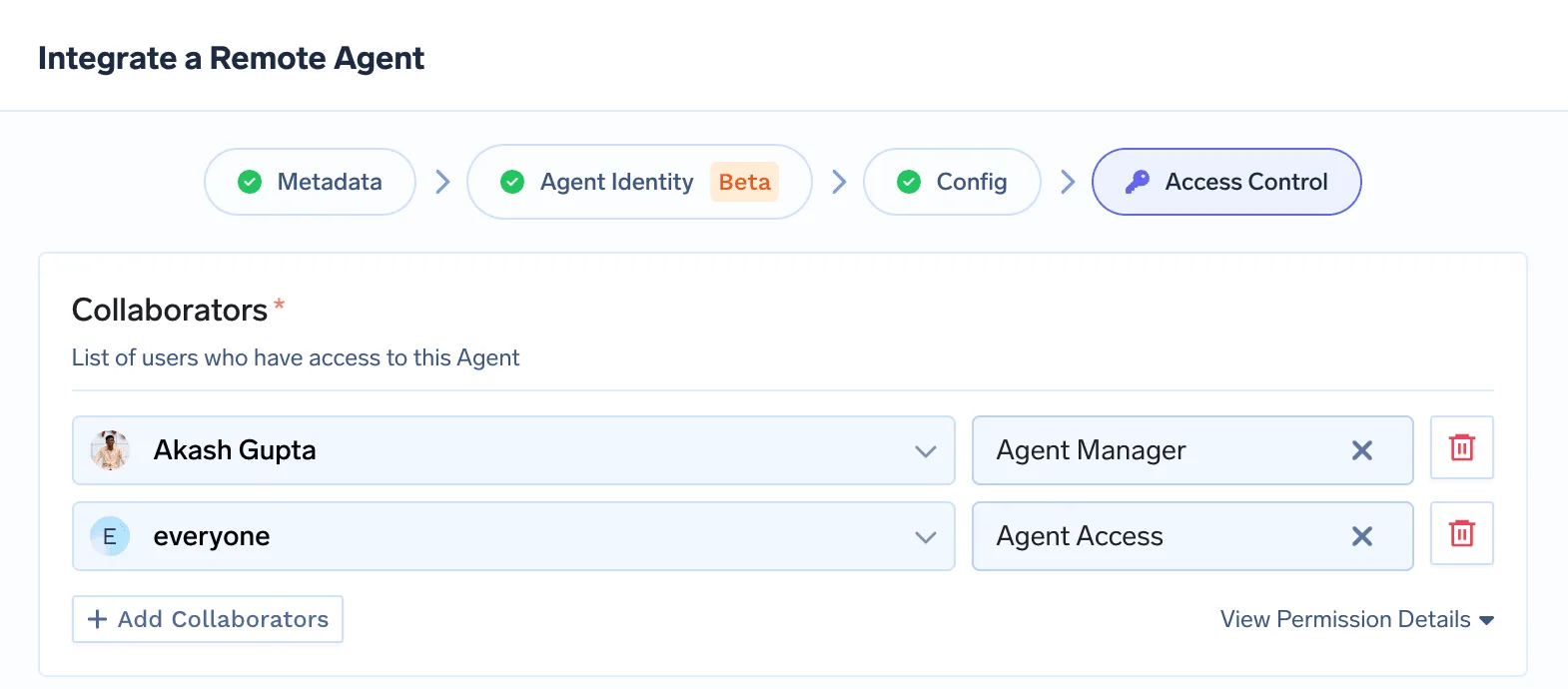
An Agent Manager can edit the agent. Agent Access can invoke it and be acted for by it. An Owner team, set separately, stays accountable for the agent from creation to retirement. Those grants are the agent's defined authority: which people it may act for, and which MCP servers and models it may reach.
The reason to register agents in one place is not tidiness. It is that the gateways deny any caller that presents no registered identity, so the Agent Registry doubles as the enforcement point. Nothing acts anonymously, and the inventory is complete by construction.
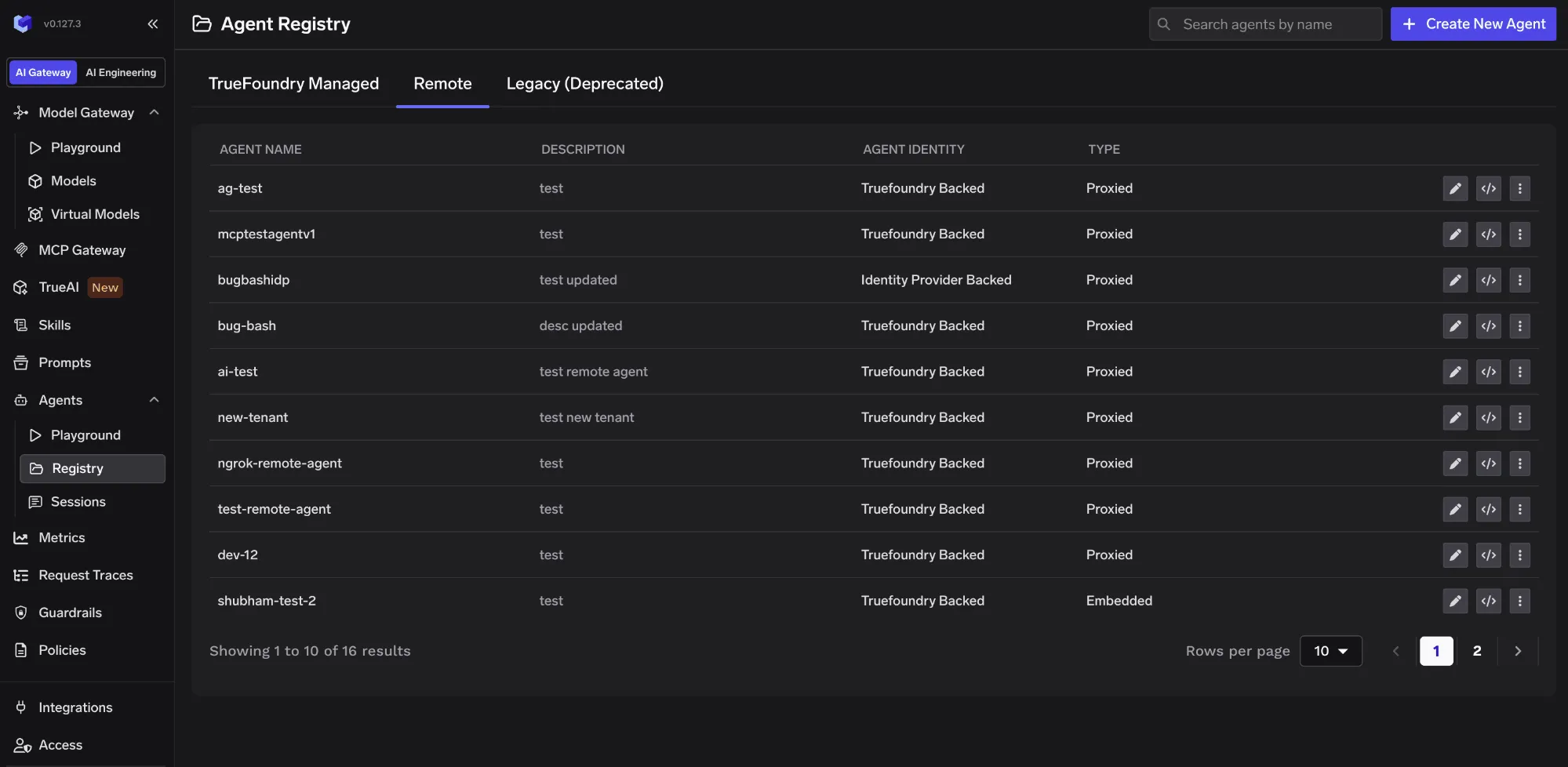
Each registry entry carries four things: a verifiable identity, an accountable owner, a defined authority (the tools, models, and people it may reach or act for), and a lifecycle that covers credential rotation and a deprovisioning path. Whatever the agent is built on, Bedrock, Vertex AI, LangGraph, a custom HTTP service, or a copilot embedded in a SaaS product, it enters governance by being registered, with nothing to move or rewrite.
Because identity is required to act, revocation is surgical. Pull one agent's identity and it stops reaching every model and MCP server at once, while every other agent keeps running. That is the kill switch that a shared service account can never give you.
Agents rarely act alone. The applications and services around them still need machine identities, and that is what virtual accounts are for. A virtual account is a non-user identity that an application or service assumes to reach resources, with a token you can auto-rotate, set rotation alerts on, and sync to your secret manager. The guidance is to create one virtual account per application and scope it to the minimum permissions it needs.
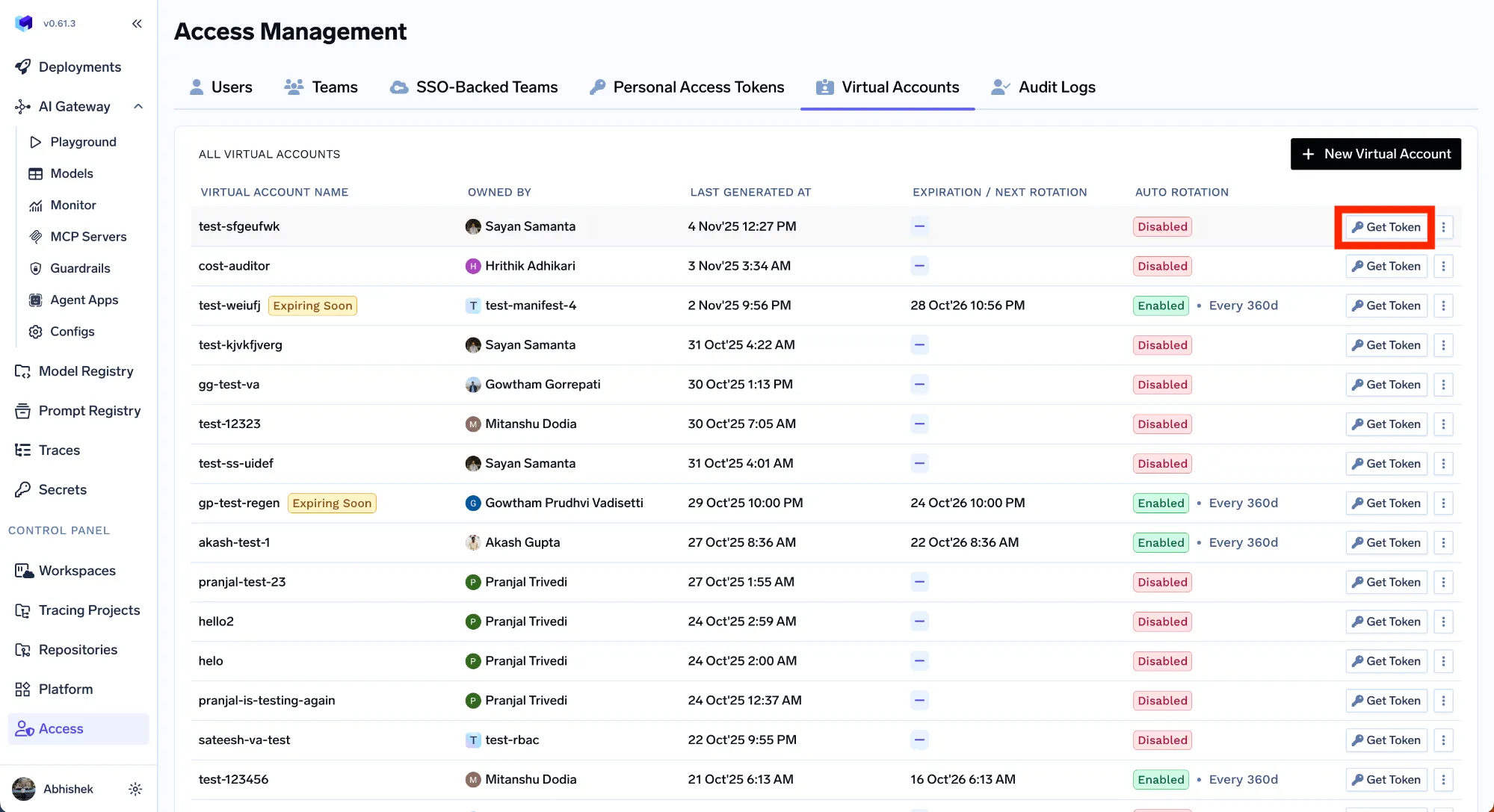
Put together, you get a clean separation of principals: people authenticate through your SSO, services and apps carry virtual accounts scoped to least privilege, and agents carry their own agent identities that can act for those people and services without ever losing attribution. Access decisions in all three cases are enforced at the gateway, and every call is inspected by AI agent guardrails for what it actually contains.
Note: Agent Identity on TrueFoundry is currently in beta, and gateway-issued per-hop token exchange is rolling out. Behavior may change as the feature matures.
An agent is not a person and it is not a static service, so it should not borrow either one's credentials. Give every agent its own AI agent identity and three hard problems get easier at once: you can attribute every action, scope each agent independently of the human driving it, and revoke a single rogue agent without downtime for the rest. On TrueFoundry that identity is created at registration and enforced at the gateway, so non-human identity stops being a spreadsheet of shared keys and becomes real infrastructure.
See how TrueFoundry issues and governs agent identity across your models, tools, and agents from one control plane. Book a demo today.
TrueFoundry AI Gateway delivers ~3–4 ms latency, handles 350+ RPS on 1 vCPU, scales horizontally with ease, and is production-ready, while LiteLLM suffers from high latency, struggles beyond moderate RPS, lacks built-in scaling, and is best for light or prototype workloads.


AI agent identity is a verifiable credential that a registered agent presents on every call, so the receiver knows which agent is calling and who it is acting for. It is a third kind of principal alongside human users and service accounts, and its defining trait is delegation: an agent identity can act on behalf of a user or service while staying identifiable as the agent.
Non-human identity is the category for anything that authenticates without a person behind it, including service accounts, workload identities, API clients, and agents. Agents are the demanding case because they act autonomously, so they need delegation rules, an owner, per-hop attribution, and a kill switch on top of the rotation and inventory a service account needs.
A service account or virtual account can only ever act as itself, so calls from many callers look identical. An agent identity can act on behalf of a specific user or service, so a single agent serving many people still produces calls that stay attributable to each one. TrueFoundry keeps all three principal types distinct and enforces them at the gateway.
You register the agent. Identity is created as part of registration, either TrueFoundry-backed or issued by your own provider such as Okta, Entra, or SPIFFE. The agent then fetches its token from the registry and presents it on every call, and the gateways deny any caller without a registered identity.
Yes. It includes an MCP Gateway, an Agent Gateway, and an MCP and Agents Registry with tool-level access control, so agents from LangGraph, CrewAI, AutoGen, or a custom framework can be governed centrally.



The latest news, articles, and resources sent to your inbox