



August 27, 2025
|
5 min read


Blazingly fast way to build, track and deploy your models!
A year ago, most AI agents lived in demos.
They answered questions, drafted emails, maybe powered an internal chatbot. If something broke, it was inconvenient, but rarely critical. Today, that’s no longer true.
AI agents are quietly moving into the nervous system of the enterprise. They’re routing customer requests, triggering workflows, touching production data, and talking to other agents. And that shift has exposed a new class of challenges that many teams weren’t designed for. Gartner recently published multiple reports on generative AI engineering, AI gateways, and MCP-based systems, referencing TrueFoundry across them. In each of these reports, one theme keeps surfacing: as AI agents move from experiments into real business workflows, the hardest problems enterprises are facing are about control, visibility, and cost.
Here are the key highlights from the reports and what they mean for enterprise teams.
GenAI is now a platform layer, not just a point solution
The first phase of GenAI inside enterprises was all about can we do this?
The next phase is about can we run this?
That shift is reflected clearly in how the market is evolving. In Gartner’s Innovation Guide for Generative AI Engineering, it points out that vendors are moving well beyond “prompting a model” and into full-fledged GenAI platforms: covering pipelines, context engineering, orchestration, and governance. As the report states, “Over the past two years, incumbent and new AI engineering vendors have raced to provide tooling and services to support GenAI pipelines beyond simplistic prompting of GenAI models…Knowledge and context engineering has emerged as the cornerstone capability distinguishing successful GenAI implementations from experimental prototypes.”
In other words: once GenAI becomes real, it stops being a collection of tools and starts behaving like infrastructure, much like how the best MLops tools evolved from isolated model utilities into full production platforms.
This is where the idea of a centralized control layer becomes unavoidable. You can let teams move fast across models, clouds, and agents—but someone (or something) needs to keep the system coherent.
In the report, Gartner places TrueFoundry in its Emerging Market Quadrant for Generative AI Engineering as an Emerging Challenger, reflecting this exact shift: GenAI treated not as scattered integrations, but as a platform with centralized control and distributed execution
Once GenAI becomes platform infrastructure—rather than a set of experiments—the pressure shifts squarely onto the people responsible for running it. The control gaps that show up at the system level quickly land on the desks of product and platform leaders.
For them, the focus has begun to shift from “How do we build agents?” to “How do we keep control once they’re running?” Multi-agent systems scale in ways that are hard to predict. One agent calls another. That agent fans out to tools. Costs spike, latencies compound, and failures cascade in places no one instrumented.
Gartner’s report Emerging Tech: AI Vendor Race – AI Gateways Usher in the Agent-to-Agent Economy puts it bluntly: “MAS (multiagent systems) will not materialize at scale in the enterprise without control and visibility across all the components of these systems.” This reflects what we’ve observed many teams already experiencing: agentic systems scale faster than the guardrails around them.
According to the same report, by 2028, 70% of software engineering teams building multimodal applications will use AI Gateways to improve reliability and optimize costs. Even sooner, by 2027, 40% of enterprises will have two or more AI Gateways deployed to control and monitor heterogeneous MAS. These forecasts reflect a growing reality inside enterprises today.
But it isn’t just organizational control, AI Gateways offer real cost benefits to companies. In its report, ‘Reduce AI Costs and Improve Reliability with AI Gateways and Model Routers’ Gartner estimates routers can “reduce inference cost by up to 85% for simple queries”.
MCP has done something important: it standardized how agents connect to tools and to each other.But anyone who’s scaled MCP servers across teams knows standardization is only the beginning.
Without a control layer, organizations quickly run into:
Gartner addresses this directly in Emerging Practices for MCP Servers and Tools, recommending that MCP servers be treated “as production APIs” and governed through a gateway-centric architecture that centralizes authentication, authorization, policy enforcement, and observability. Gartner lists TrueFoundry under AI and Agent Gateways with MCP support, underscoring a broader takeaway for teams: scaling agentic systems isn’t just about protocols, it’s about putting the right control structures in place before experimentation turns into operational debt.
Enterprises don’t usually feel architectural shifts all at once. They show up as small frictions at first—an unexpected cost spike, an agent that behaves differently in production, a security review that suddenly takes weeks instead of days. Over time, those frictions accumulate into a realization: the system has outgrown the way it’s being managed.
That’s the moment many teams are hitting with agentic AI.
Gartner’s recent research reflects this inflection point. Not because AI gateways are new, but because the problems they solve have become unavoidable. As agents multiply and responsibilities blur across models, tools, and teams, a centralized control layer stops being optional infrastructure and starts becoming a prerequisite for scale.
The teams that get this right won’t just ship faster—they’ll know what’s running, why it’s running, and how to change it without breaking everything else. That’s the difference between experimenting with AI and operating it.
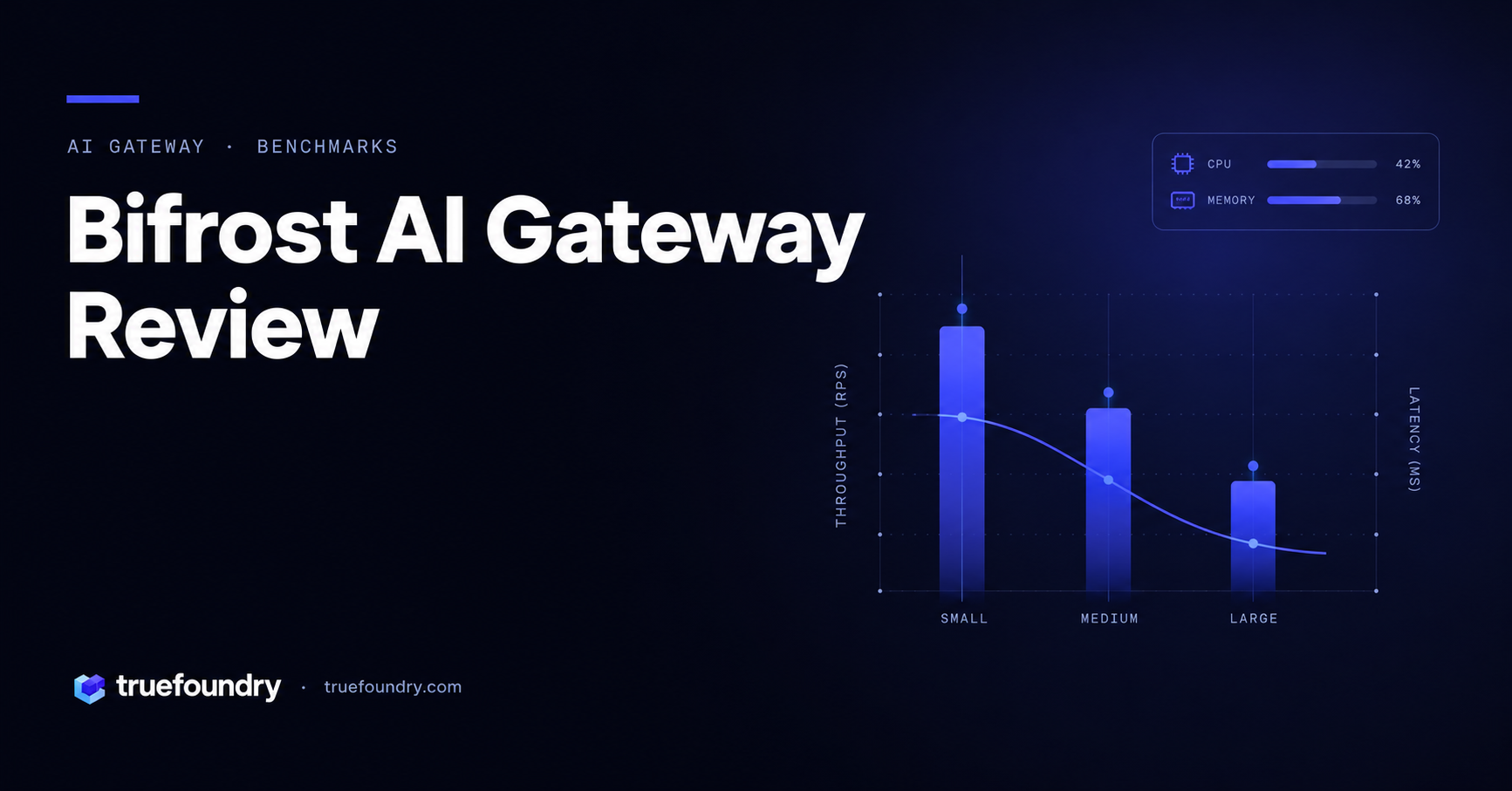
TrueFoundry AI Gateway delivers ~3–4 ms latency, handles 350+ RPS on 1 vCPU, scales horizontally with ease, and is production-ready, while LiteLLM suffers from high latency, struggles beyond moderate RPS, lacks built-in scaling, and is best for light or prototype workloads.






The latest news, articles, and resources sent to your inbox
.webp)

.webp)

.png)
.png)
.png)
.png)
.png)
.png)
.png)
.png)
.png)

.png)
.png)


