


August 31, 2026
|
5 min read


Blazingly fast way to build, track and deploy your models!
For many engineering teams, Vertex AI starts as a convenience and ends as a constraint. While powerful, it often forces a trade-off: you get tight integration with Google services, but you lose control over your infrastructure, face opaque "always-on" costs, and suffer from strict vendor lock-in.
But 2026 is the year of open, portable AI. Engineering teams are increasingly moving away from closed "walled gardens" toward platforms that allow them to deploy models anywhere, be it AWS, Azure, on-prem, or hybrid setups.
If you are looking for alternatives that offer better cost visibility, true multi-cloud portability, or specialized workflows for GenAI, you are in the right place. Let’s look at the competitors that are giving Vertex AI a run for its money.
Vertex AI is a unified and integrated AI platform from Google Cloud designed to assist data scientists and developers in creating, training, and deploying machine learning models with efficiency and ease. Vertex AI amalgamates Google Cloud services for AI into a single environment, offering a broad range of tools from pre-trained APIs to AutoML and AI Platform. Noteworthy features of Vertex AI include its seamless integration with Google Cloud storage and analytics, an extensive library of pre-trained AI components, and the ability to automate and streamline the deployment of AI solutions.
The platform is engineered to optimize the entire machine learning workflow, which includes the processes of building, training, and deploying models. With Vertex AI, you benefit from state-of-the-art AI and ML tools that leverage Google's cutting-edge technology and services. It's tailored to facilitate scaling from prototype to production without having to manage the underlying infrastructure, thanks to its auto-scaling capabilities and fully managed services.
Pricing : Vertex AI employs a pay-as-you-go model, similar to other Google Cloud services, where charges are based on the resources utilized, such as compute hours, data processing, and storage. Google Cloud provides cost estimation tools to help manage expenses effectively.
Vertex AI may be an appropriate choice if :
Reasons for Exploring Alternatives to Vertex AI :
While Vertex AI is a powerful solution for AI and ML projects, potential users should consider the platform's learning curve, especially those new to Google Cloud. Additionally, for some projects, the costs could escalate with increased usage of certain features like AutoML. Users who wish to avoid vendor lock-in or require a more agnostic platform in terms of cloud services may also look for other options. Each project's unique needs must be considered to determine if Vertex AI is the optimal platform for developing and deploying ML models.
Moving away from Vertex AI isn't just about swapping tools; it's about regaining control over your infrastructure and costs. While Vertex AI excels at integration within the Google ecosystem, the alternatives below prioritize portability and modularity.
We have curated this list to highlight platforms that allow you to build and deploy models where you want, whether that is to reduce inference costs, access specific GPU availability, or simply avoid vendor lock-in.
Here are the top Vertex AI competitors we will cover:

TrueFoundry is designed to significantly ease the deployment of applications on Kubernetes clusters within your own cloud provider account. It emphasizes data security by ensuring data and compute operations remain within your environment, adheres to SRE principles, and is cloud-native, enabling efficient use of various cloud providers' hardware. Its architecture provides a split plane comprising a Control Plane for orchestration and a Compute Plane where user code runs, aimed at secure, efficient, and cost-effective ML operations.
Moreover, TrueFoundry excels in offering an environment that streamlines the development to deployment pipeline, thanks to its integration with popular ML frameworks and tools. This allows for a more fluid workflow, easing the transition from model training to actual deployment. It provides engineers and data developers with an interface that prioritizes human-centric design, significantly reducing the overhead typically associated with ML operations. With 24/7 support and guaranteed service level agreements (SLAs), TrueFoundry assures a solid foundation for data teams to innovate without the need to reinvent infrastructure solutions.
Pricing : The startup plan begins at $0 per month, offering free access for one user for two months, while the professional plan starts at $500 per month, adding features like multi-cloud support and cloud cost optimizations. For enterprises, custom quotes are provided to suit specific needs, including self-hosted control planes and compliance certificates.
Limitations : TrueFoundry's extensive feature set and integration capabilities may introduce complexity, leading to a steep learning curve for new users.


Amazon SageMaker is AWS's flagship fully managed machine learning service, designed to be the comprehensive "workshop" for every step of the ML lifecycle. Ideally suited for teams already deeply integrated into the AWS ecosystem, it provides a vast array of tools ranging from data labeling (Ground Truth) and building (SageMaker Studio) to training and deployment.
Beyond traditional ML, SageMaker has aggressively expanded into Generative AI. Through integration with Amazon Bedrock and SageMaker JumpStart, it provides access to a wide range of foundation models (like Anthropic’s Claude and Meta’s Llama) that can be fine-tuned and deployed securely within your VPC.
Pricing: Amazon SageMaker follows a granular pay-as-you-go model where you are billed per second for compute, storage, and data processing used. It offers a Free Tier (e.g., 250 hours of notebook usage) for experimentation, but production costs can scale quickly based on the instance type (CPU vs. GPU) and running time. For long-term predictability, AWS offers Savings Plans that can reduce costs by up to 64% in exchange for a 1- or 3-year usage commitment.
Limitations: The platform’s primary drawback is its complexity and steep learning curve; the sheer number of features and IAM permission configurations can be overwhelming for smaller teams or those without dedicated DevOps support. Additionally, cost management requires vigilance; "always-on" inference endpoints charge you even when idle, and unlike some serverless alternatives, scaling down to absolute zero can be slower or require specific asynchronous configurations.
.webp)
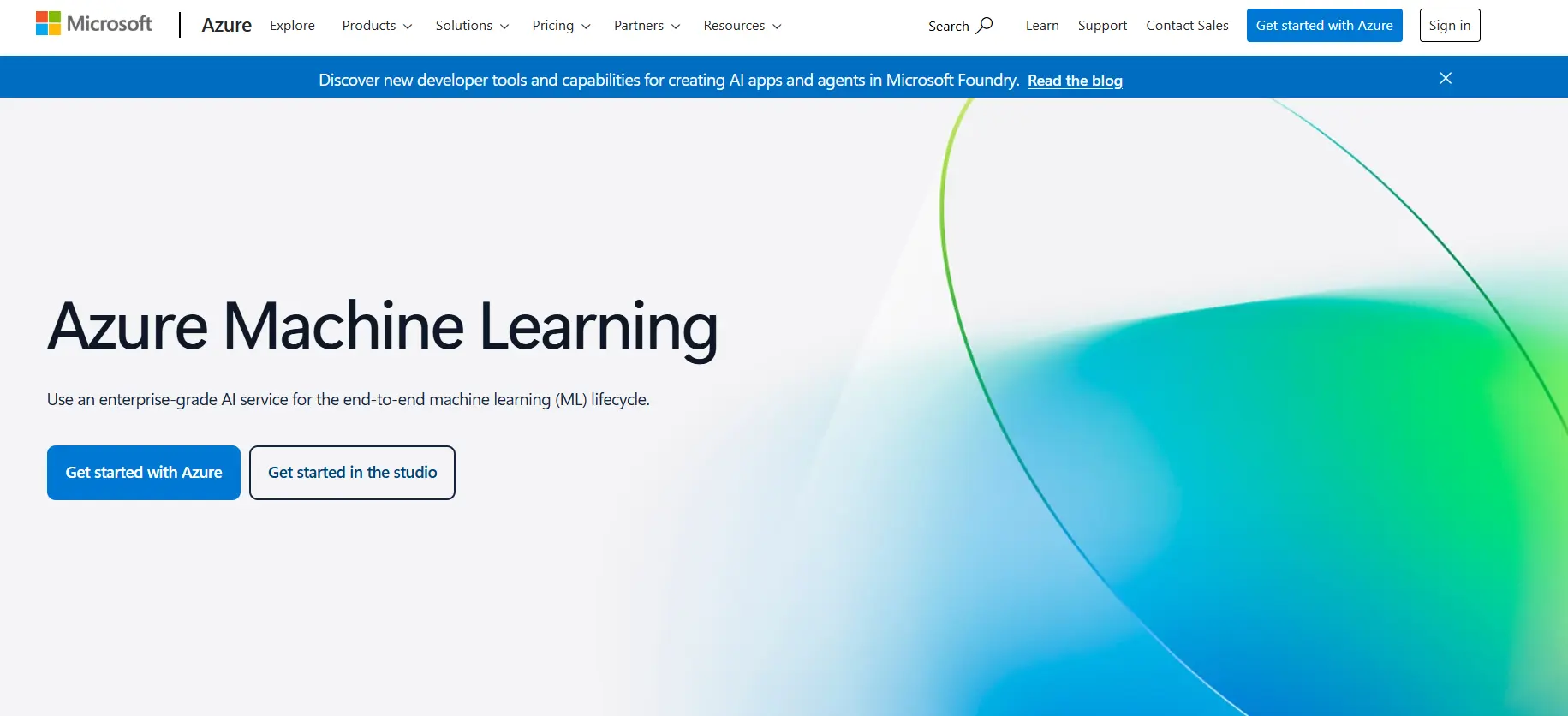
Azure Machine Learning (Azure ML) is the top-tier contender for enterprises relying on the Microsoft stack. Its seamless integration with Microsoft tools (like Power BI, Excel, and Synapse Analytics) makes it an exceptionally strong choice for organizations looking to democratize AI across different business units.
For Generative AI, Azure ML is currently a market leader due to its exclusive ease of access to OpenAI’s models (GPT-4, DALL-E) via the Azure OpenAI Service. It allows companies to fine-tune and deploy these powerful models within a secure enterprise boundary, ensuring that sensitive corporate data remains protected and compliant with standards like HIPAA and GDPR.
Pricing: Azure Machine Learning operates on a consumption-based pricing model where there are no upfront costs or termination fees. You primarily pay for the Virtual Machines (compute) used for training and inference, along with associated storage and networking costs. While the base service is free, costs can accrue from specific managed services (like Azure OpenAI), which are billed based on token usage or hourly throughput.
Limitations: While user-friendly, Azure ML can feel restrictive for teams that need deep infrastructure control; for instance, it imposes strict quotas on cores per region that can bottleneck massive training jobs. Furthermore, it is heavily optimized for data residing in Azure (Blob Storage, Data Lake); if your data lives in AWS S3 or Snowflake, building efficient pipelines can be more cumbersome and result in higher latency compared to using a cloud-agnostic platform.
.webp)
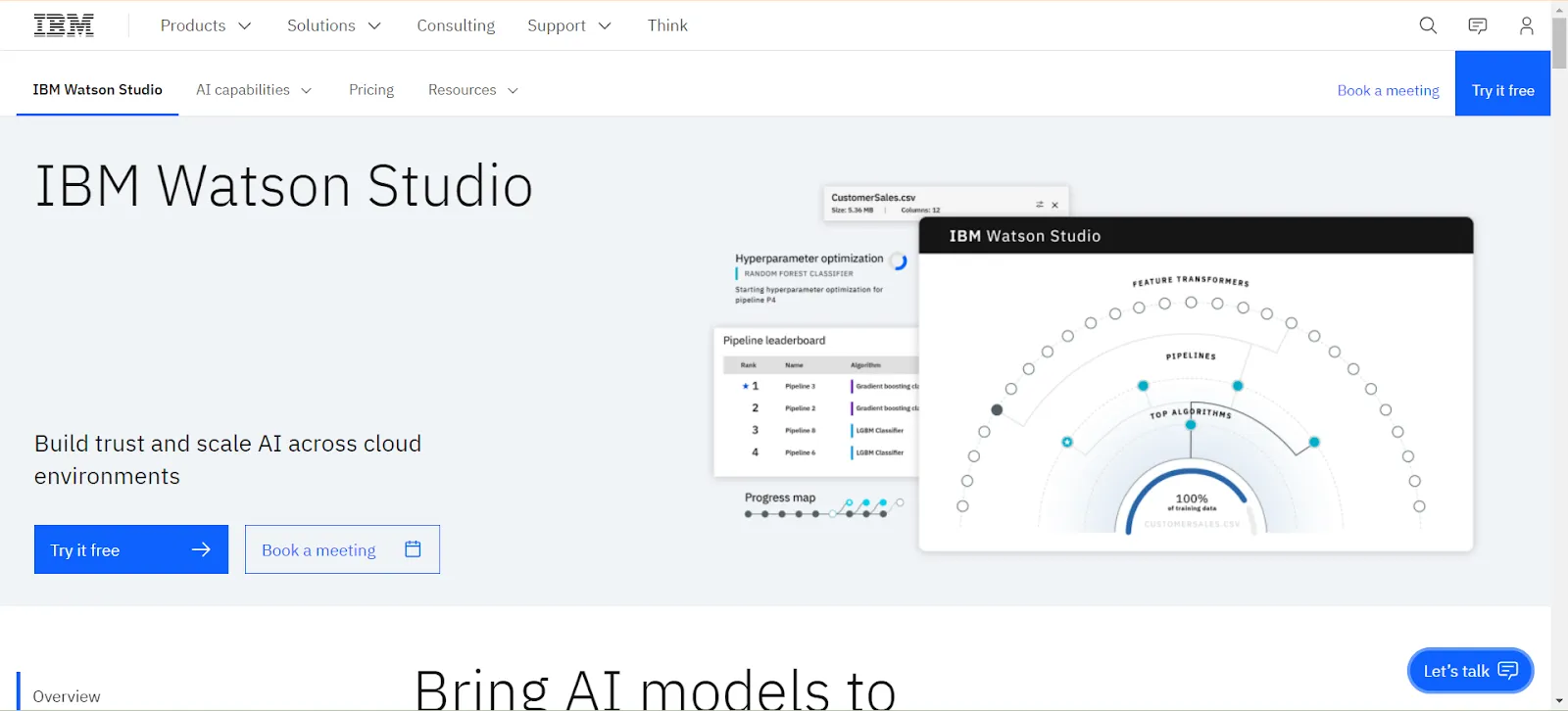
IBM Watson Studio is a multifaceted environment that bolsters data scientists, developers, and analysts in their efforts to create, train, and manage AI models. The platform is renowned for its powerful machine learning capabilities and is fortified by IBM's deep learning and artificial intelligence technology. It serves as a collaborative platform that unites open source frameworks like PyTorch, TensorFlow, and scikit-learn with IBM's proprietary tools, offering both code-based and visual data science workflows. The comprehensive nature of Watson Studio is evident in its support for a variety of data sources, facilitating a streamlined workflow for building, training, and deploying machine learning models at scale.
In addition to advanced features like automated machine learning (AutoAI) and model monitoring, Watson Studio grants access to pretrained machine learning models such as Visual Recognition and Watson Natural Language Classifier. Its use of Jupyter Notebooks alongside other scripting languages positions it as a robust solution for project collaboration and deployment across different environments, including on-premises or as a SaaS solution in IBM's private cloud.
Pricing : IBM Watson Studio features a flexible pay-as-you-go pricing model, starting at $99 per month for the standard cloud version, making it accessible for various project sizes, while enterprise solutions offer more extensive packages at $6,000 per month with 5,000 capacity unit hours and a desktop version at $199 per month for unlimited modeling.
Limitations : While the platform is highly capable, new users, particularly those without prior data science experience, may find it challenging to navigate the comprehensive toolset and integration points. This could result in a steep learning curve and may necessitate additional training or support to leverage the platform fully. Moreover, like many robust platforms, large-scale deployments could potentially result in increased costs due to the advanced nature of the services used.


Databricks Data Intelligence Platform is a cohesive and comprehensive environment that facilitates the end-to-end analytics and machine learning workflow, just as Vertex AI does within the Google Cloud ecosystem. It is built on a lakehouse architecture, combining the best elements of data lakes and data warehouses to offer a single source of truth for all data workloads. Databricks stands out with its generative AI and large language models, integrated with a data lakehouse that helps to understand the semantics of your data and automatically optimizes performance for your business needs.
The platform offers tools for data processing, scheduling, management, ETL operations, dashboard generation, and machine learning modeling, tracking, and serving. It supports a variety of programming languages and provides seamless integration with open-source projects like Delta Lake, MLflow, and Apache Spark.
Pricing : Databricks operates on a pay-as-you-go model with the option for committed-use discounts, which offers cost benefits when committing to certain levels of usage. They offer a free trial for new users and a range of products designed for different workloads with prices starting at $0.07 per DBU for workflows and streaming jobs.
Limitations : However, as with any comprehensive data platform, there may be a learning curve, especially for those new to such extensive data processing and machine learning systems. Also, depending on the services and the scale of operations, costs can escalate, so it’s important to consider these factors when choosing Databricks as a data intelligence platform.


Seldon Core is an open-source platform designed to simplify the deployment, scaling, and management of machine learning models on Kubernetes. It provides a powerful framework for serving models built with any machine learning toolkit, enabling easy wrapping of models into Docker containers ready for deployment. Seldon Core facilitates complex inference pipelines, A/B testing, canary rollouts, and comprehensive monitoring with Prometheus, ensuring high efficiency and scalability for machine learning operations.
Pricing : Being open-source, Seldon Core itself does not incur direct costs, although operational costs depend on the underlying Kubernetes infrastructure.
For a detailed exploration of Seldon Core's capabilities and documentation, visit their GitHub repository and official documentation.
Limitations : The initial setup requires a good understanding of Kubernetes, which may present a steep learning curve for those unfamiliar with container orchestration. Also, while it supports a wide range of ML tools and languages, customization or use of non-standard frameworks can complicate the workflow. Some advanced features, like data preprocessing and postprocessing, are not supported when using certain servers like MLServer or Triton Server . Additionally, the documentation, although extensive, may be lacking for advanced use cases and occasionally leads to deprecated or unavailable content.


MLflow is an open-source platform designed to manage the ML lifecycle, including experimentation, reproducibility, and deployment. It offers four primary components: MLflow Tracking to log experiments, MLflow Projects for packaging ML code, MLflow Models for managing and deploying models across frameworks, and MLflow Registry to centralize model management. This comprehensive toolkit simplifies processes across the machine learning lifecycle, making it easier for teams to collaborate, track, and deploy their ML models efficiently.
Pricing : MLflow is free to use, being open-source, with operational costs depending on the infrastructure used for running ML experiments and serving models.
For a deeper understanding of MLflow, its features, and capabilities, consider exploring its documentation and GitHub repository.
Limitations : MLflow is versatile and powerful for experiment tracking and model management, but it faces challenges in areas like security and compliance, user access management, and the need for self-managed infrastructure. Moreover it has issues with scalability and the number of features are also limited.


Valohai is an MLOps platform engineered for machine learning pioneers, aimed at streamlining the ML workflow. It provides tools that automate machine learning infrastructure, empowering data scientists to orchestrate machine learning workloads across various environments, whether cloud-based or on-premise. With features designed to manage complex deep learning processes, Valohai facilitates the efficient tracking of every step in the machine learning model's life cycle.
Pricing : Valohai offers three options: SaaS for teams starting out with unlimited cloud compute, Private for enhanced functionality and speed with the choice of cloud or on-premise compute, and Self-Hosted for maximum security and scalability, enabling full control over ML operations on preferred infrastructure.
Limitations : Valohai promises to automate and optimize the deployment of machine learning models, offering a comprehensive system that supports batch and real-time inferences. However, users looking to utilize this platform must manage the complexity of integrating it within their existing systems and might face challenges if they're unfamiliar with handling extensive ML workflows and infrastructure management.

Tools like Vertex AI and its hyperscaler cousins are powerful, but they often force you to spend more time managing infrastructure permissions and proprietary configurations than actually improving your models.
The best alternative should not just replace Vertex AI; it should simplify it.
At TrueFoundry, we believe infrastructure should be invisible. We provide a developer-centric platform that automates the heavy lifting of Kubernetes, cost optimization, and model serving, allowing you to deploy to any cloud with a single command.
Stop wrestling with cloud consoles. Get started for free with TrueFoundry and see how fast you can go from "model in notebook" to "production API."
When evaluating top Vertex AI alternatives, platforms like Databricks are similar, but they often lack flexibility. TrueFoundry stands out as a superior choice by offering a multi-cloud architecture that prevents vendor lock-in, unlike standard hyperscaler options.
No, but SageMaker is often cited as a primary Vertex AI alternative for AWS users. Unlike both, TrueFoundry unifies deployments across all clouds (AWS, GCP, Azure), eliminating the fragmented tooling typical of single-vendor ecosystems.
Azure Machine Learning is the direct Vertex AI competitor within the Microsoft ecosystem. However, for teams seeking a cloud-agnostic solution, TrueFoundry provides a more cost-effective control plane that works seamlessly on top of Azure infrastructure.
Major Vertex AI competitors include Amazon SageMaker, Azure Machine Learning, and Databricks. Other notable alternatives are IBM Watson Studio for hybrid environments, MLflow for open-source lifecycle management, and TrueFoundry for cost-efficient, portable deployments.
If you need a vertex ai competitor for model deployment, Vertex is the correct category, whereas Avalara is strictly for tax compliance. For engineering teams prioritizing GenAI flexibility over tax tools, TrueFoundry offers better control and ROI than Vertex AI.
TrueFoundry AI Gateway delivers ~3–4 ms latency, handles 350+ RPS on 1 vCPU, scales horizontally with ease, and is production-ready, while LiteLLM suffers from high latency, struggles beyond moderate RPS, lacks built-in scaling, and is best for light or prototype workloads.






The latest news, articles, and resources sent to your inbox


.webp)

.webp)

.png)
.png)
.png)
.png)
.png)
.png)
.png)
.png)
.png)
.png)
.png)


