


.webp)
October 24, 2026
|
5 min read


Blazingly fast way to build, track and deploy your models!
AGENT ECONOMICS · No. 1 IN AN OPEN SERIES · No. 2: the instruments →
The phrase is suddenly everywhere and rarely defined, so let us start there: an agent economy is a system in which autonomous software agents — acting on behalf of people, organizations, or other systems — hold budgets, discover one another, and transact: buying compute, data, tool calls, and services from each other and from the human economy, at machine speed. Once you have that definition, three questions follow immediately, and they organize this entry: how would you describe such an economy precisely (Section 1, with just enough math to be useful), why believe it is arriving now rather than in some vague future (Section 2), and — the contested one — who gets to design its rules? On that last question this post draws chiefly on two complementary sources: MIT Sloan's July 2026 report on MIT Media Lab professor Ramesh Raskar, leader of Project NANDA, who argues the durable opportunity is building the market infrastructure agents will need (mitsloan.mit.edu); and the Google DeepMind preprint Virtual Agent Economies by Nenad Tomašev and colleagues, whose "sandbox economy" framework holds that an agent economy's structure should be a design decision rather than an accident of adoption speed (arXiv:2509.10147). One asks who will own the rails; the other asks what the market's physics should be. We are marking this plainly as the first entry in an open series on agent economics — open because the field is moving too fast to promise a table of contents — and we close with the ledger of questions the series will keep returning to.
Informally: an agent economy is what you get when the transacting parties are software. Slightly more carefully, and at no more than sophomore level: let A be a set of agents and P a set of principals (people and organizations), with each agent tied to a principal by a mapping p: A → P — the answer to "on whose behalf?" Give each agent a budget b(a) ≥ 0, the resources its principal has delegated. A transaction is a triple (buyer, seller, v) with value v > 0, where each side may be an agent or a human-economy actor; the economy over some period is the set T of such transactions, with total volume V = Σ v. The paper’s two axes are qualitative. For discussion, define a toy permeability statistic — not proposed by the authors: π = Vcross / (Vinternal + Vcross), counting each transaction once. Values near zero indicate relatively limited cross-boundary transaction volume; values near one indicate extensive interleaving — and one important source of systemic risk is how fast π grows relative to the institutions that police the boundary. Origins remains categorical, a fact about the market mechanism M (who may join, how prices form, how disputes resolve): was M deliberately designed, or did it accrete? Three observations fall out of even this toy framing. Transaction volume can outpace transaction-by-transaction human review, so oversight tends to attach to M — the mechanism — rather than to individual transactions. Budgets constrain possible demand; whoever sets b(·) bounds what the participating agents may spend. And identity is one load-bearing institution: without a trustworthy p(·), no one can say whose preferences a transaction served — which is why the treatments examined here, whatever their politics, land on identity, trust, and payments among the missing institutions.
Raskar and the DeepMind authors begin from the same observation dressed in different vocabulary: agents change what kind of thing is doing the transacting. The DeepMind authors describe modern agents as flexible capital — automating cognitive work across domains rather than a single task — and point to the arrival of interoperability standards, naming Agent2Agent and the Model Context Protocol, as the signal that a genuinely new economic layer is forming: a growing connective layer through which software agents can discover capabilities, coordinate work, and — where separate payment infrastructure exists — participate in transactions. Raskar's version is demographic: in his telling, every person, organization, and object plausibly acquires agents — his list runs from cities to refrigerators to baseball teams — putting the eventual population in the billions or trillions. Whether either estimate lands precisely is beside the point both are making: at that population and speed, the interesting questions stop being about model quality and become about market structure. Economics, in other words, arrives whether anyone invites it. And the "now" is no longer only visionary: on the adoption side, BCG's AI at Work 2026 survey (≈11,749 workers, 14 markets) reports roughly 30% of respondents saying their organizations have integrated AI agents into workflows, up from 13% the prior year (bcg.com); on the infrastructure side, in 2026, machine-facing identity and payment infrastructure became more visibly institutionalized — an IETF working group developing cryptographic authentication for automated clients accessing websites (Web Bot Auth; its charter excludes HTTP APIs, agent-to-agent interfaces, and reputation assignment), a Linux Foundation home for the x402 machine-payments protocol, and, as of July 1, Cloudflare's waitlisted gateway for pricing content and tools to machine callers — developments this blog examined in depth in our egress-governance analysis. Adoption is measurable and the rails are being laid; the definition above is acquiring a referent.
Raskar's core move is an inversion he states in five words — the future economy, he argues, is one where we say "Let's create X for agents" rather than building agents for X. (That is this post's one quotation from the Sloan report; the rest is paraphrase.) The claim is historical as much as predictive: the durable fortunes of the web were made less by individual websites than by the layers websites needed — naming, search, payments, trust. His illustrative categories for the agent era, with their explicit analogies, translate directly into an infrastructure shopping list:
Around the list sits the report's real tension. Raskar's structural analogy — the mainframe era of AI giving way to a PC era as compute costs fall — is optimistic about distribution; his political forecast is not. He tells Sloan that most paths from here lead to a consolidated agentic web resembling today's platform incumbencies rather than the open web's foundational layer, and that the window for keeping it open is closing though not yet closed — the reason Project NANDA exists. For a business audience the actionable content survives either outcome: the categories in the table are markets someone will own, open or not.
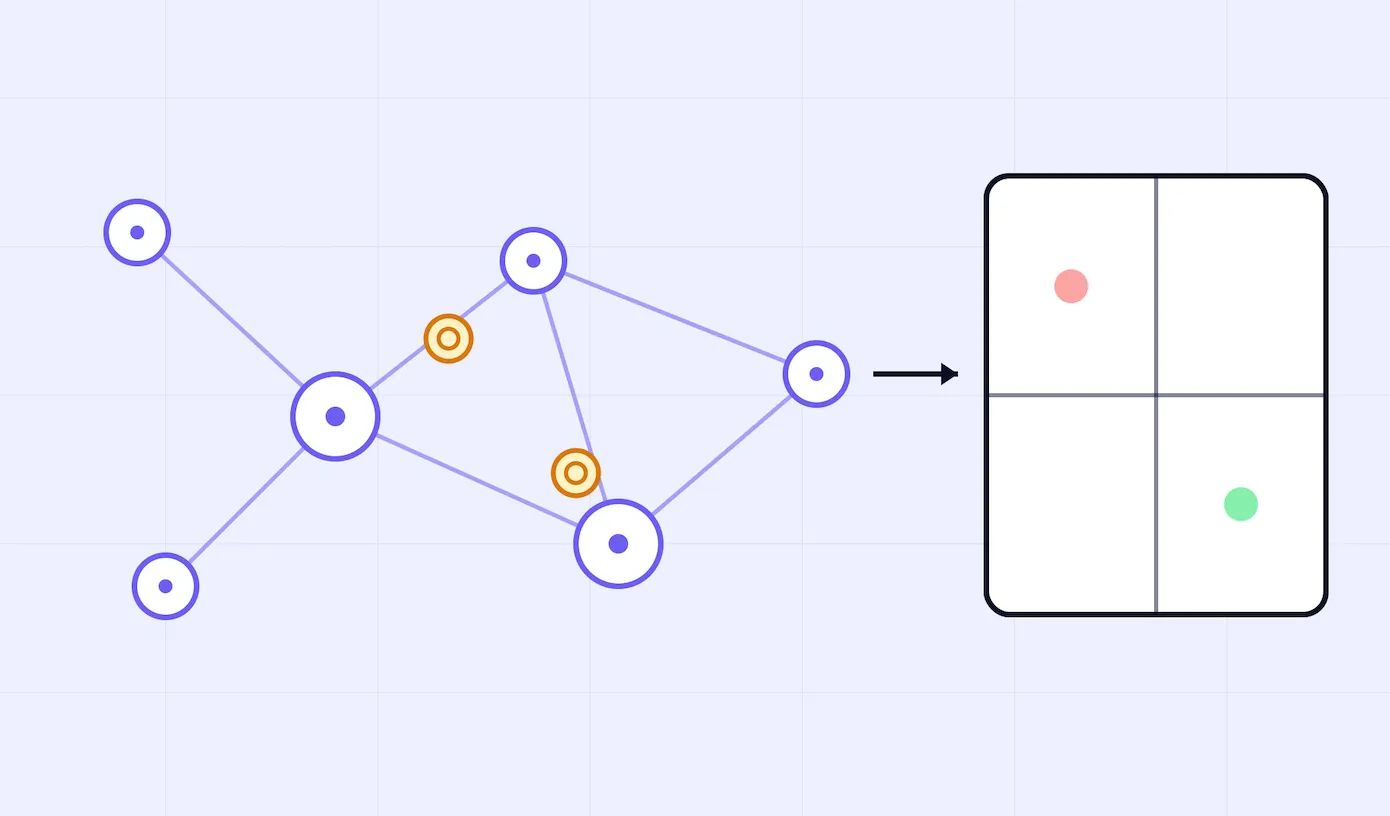
Where the Sloan report supplies vision and stakes, the DeepMind preprint supplies the analytical machinery — and it is the reason we treat it as this post's second main reference. Virtual Agent Economies proposes analyzing any agent economy along two dimensions. Origins: did the economy emerge spontaneously as agents were adopted, or was it intentionally designed? Permeability: how freely does value flow between the agent economy and the established human economy? Cross the axes and you get the space in Figure 1 — with the paper's uncomfortable diagnosis marked in red: our current trajectory points toward the emergent, highly permeable quadrant, where agent markets simply interleave with human ones as fast as adoption allows, importing coordination benefits and systemic risks in the same motion. The authors' catalog of the latter is soberly macro: contagion from agent-market instability into human markets, and the exacerbation of inequality as flexible capital accrues to those who already own capital.
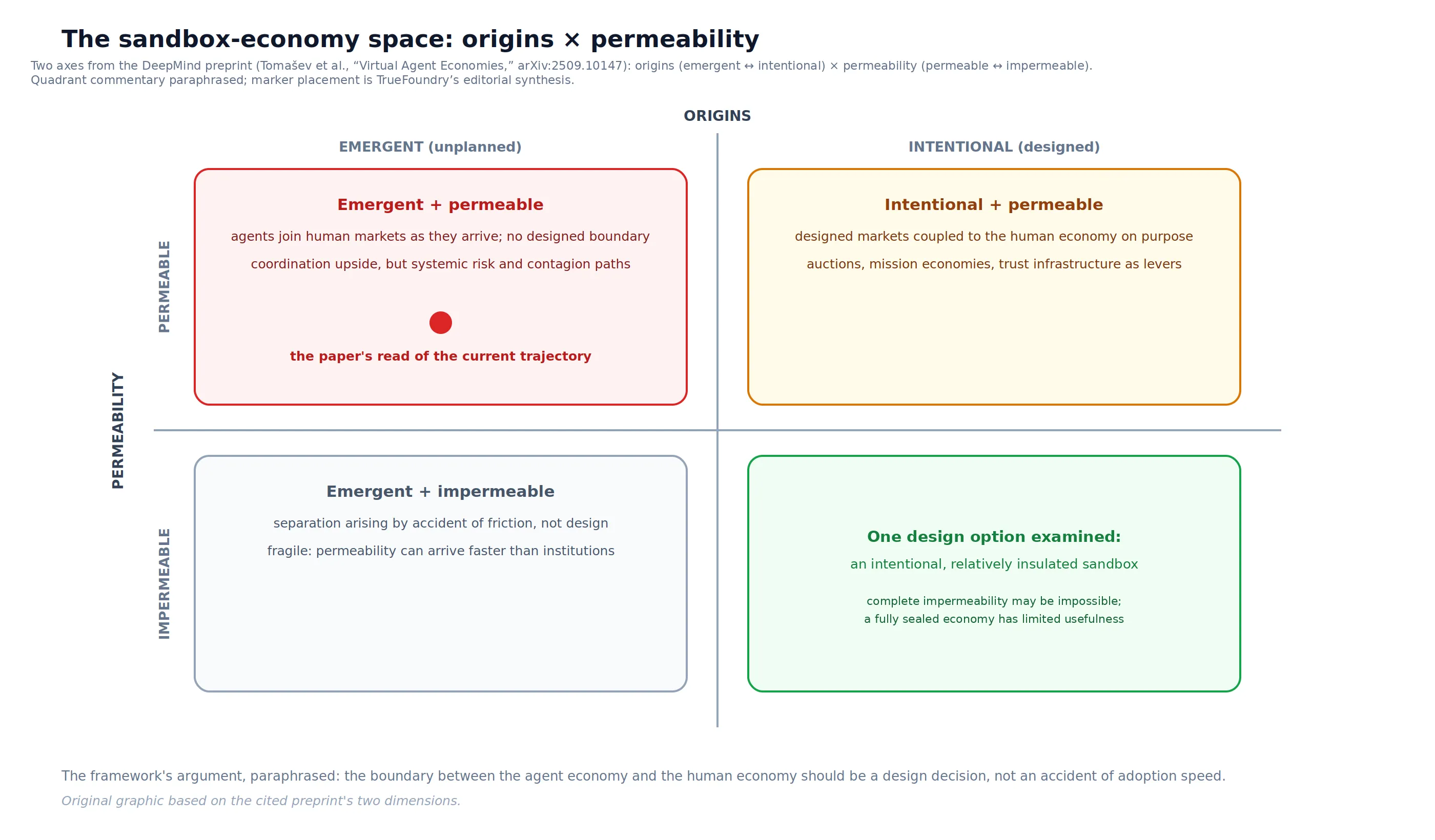
The constructive half of the paper is a designer's toolkit for moving off the default trajectory, and its instruments are recognizably economic rather than merely technical: auction mechanisms for allocating scarce resources among agents and resolving conflicting preferences fairly; mission economies that orient agent markets around collective goals instead of leaving objective-setting entirely to market drift; infrastructure of trust so counterparties can transact without shared humans behind them; and — the most striking instrument — bespoke currencies for agents, valuable precisely because a currency boundary is a permeability dial: it partially insulates high-frequency agent transactions from the human economy and limits contagion by construction. The through-line is the paper's quiet thesis: permeability should be a decision, not an accident of adoption speed.
Put side by side, the Sloan report and the DeepMind preprint ask complementary questions about the same object. Raskar asks who will own the rails — his axis is open versus consolidated, his fear a half-dozen companies owning the agentic web the way they came to own social media. The DeepMind authors ask what the market's physics should be — their axes are origins and permeability, their fear an unplanned coupling between machine-speed markets and human ones. The convergences are more instructive than the differences: both camps name identity, trust, and payments as the missing institutions; both hold that the formative decisions are being made now, by default where not by design; and both, notably, treat protocol standards as economically significant — Raskar through NANDA's registries and interoperability work, the preprint by citing MCP and A2A as the connective tissue of the new layer. The difference in optimism is real (Raskar handicaps the open outcome bluntly; the DeepMind authors write as designers who assume steering is possible) and worth tracking as this series continues — it is, at bottom, a disagreement about whether institutions get built before or after the first crisis.
Here is the vantage point this blog adds, and the reason this series runs on infrastructure pages at all: while the macro debate proceeds, enterprise agent deployments offer a useful, bounded test case for the sandbox framework. Where participation is deliberately configured and selected model or tool operations pass through governed gateways, parts of the estate may resemble an intentional firm-scale sandbox — not a complete economy, and with a broader boundary that is not thereby impermeable. What those estates do have are working control mechanisms rather than proposals: budgets, attribution, a tool registry, rate limits, traces. That claim deserves more than a paragraph, so it gets its own entry: No. 2 in this series maps each institution the research calls for — Raskar's four infrastructure categories and the DeepMind design levers — to a documented TrueFoundry instrument, including the places where the mapping visibly thins. One preview survives here because it is where macro and micro physically touch: the permeability dimension is becoming a real configuration surface as the public web acquires signed agent identity (Web Bot Auth) and machine micropayments (HTTP 402/x402) — plumbing we analyzed in our egress-governance post.
An open series needs a spine, so here is ours — the questions we consider live, with the entry that opens them on record. (1) Pricing agent work: when agents buy from agents, what do prices carry — cost, quality signals, reputation — and who sets the reserve? (2) The permeability policy question: which transactions should cross the agent-human boundary freely, and does the bespoke-currency idea survive contact with regulation? (3) The micropayment stack: does the 402/x402 trajectory become the settlement layer Raskar's fourth category calls for, and at what fee structure? (4) Market power measurement: what is the concentration metric for an agent economy — share of registry entries, of settlement volume, of identity issuance? Raskar's nine-in-ten warning needs an observable. (5) Liability and insurance: when an agent errs at machine speed, where does the loss land, and what does an actuarial table for agents even condition on? (6) Firm-level evidence: what do enterprise gateways' own ledgers — attribution data, budget events, trace records — reveal about how agent economies actually behave when the walls are real? (No. 2 opens this one.) Each future entry will pick up one or more of these; the numbering of this series will grow as the field gives us reasons.
Three disclosures keep this entry faithful to its sources. Virtual Agent Economies is an arXiv preprint — serious authors, not yet the peer-reviewed record — and we present its framework as a proposal, not a finding. The Sloan report presents Raskar's views, forecasts, and probability estimates as his own; population figures like billions or trillions of agents are vision-setting, not measurements. And the firm-scale sandbox-analogue mapping of Section 6, along with the marker placement in Figure 1, is TrueFoundry's editorial synthesis: the platform capabilities cited are documented, but neither publication evaluates or endorses TrueFoundry, and no gateway resolves questions of ownership or systemic design. Those are exactly the questions worth a standing series — which is why this one is now open.
Series: Agent Economics, No. 1 · Next → No. 2: Mapping Firm-Scale AI Controls to Agent-Economy Institutions
First entry in an open series on agent economics; future entries will pick up the Section 7 ledger as evidence accrues, without a predetermined count. One short quotation is used from the Sloan report. Terminology from the DeepMind preprint is attributed inline; its substantive arguments are otherwise paraphrased with links. The firm-level mapping and figure-marker placement are TrueFoundry editorial synthesis; platform capabilities are paraphrased from public documentation current at the time of writing.
TrueFoundry AI Gateway delivers ~3–4 ms latency, handles 350+ RPS on 1 vCPU, scales horizontally with ease, and is production-ready, while LiteLLM suffers from high latency, struggles beyond moderate RPS, lacks built-in scaling, and is best for light or prototype workloads.






The latest news, articles, and resources sent to your inbox


.webp)

.png)
.png)
.png)
.png)
.png)
.png)
.png)
.png)
.png)

.png)
.png)


